Precision Stamped & Deep-Drawn Metal Components for Robotics
Balford manufactures precision stamped and deep-drawn metal components for robotics and automation systems — stepper and PM motor claw poles, DC motor end caps, thin-wall rotor and isolation sleeves, anti-vibration bushings and power-module base plates for robot controllers. Production follows ISO 9001:2015 with IATF 16949-aligned quality controls on a 12,000 m² facility with 500+ machines.
Why Balford for Robotics
- Stamped motor cores and frames. Claw poles and claw-pole stators for stepper and PM motors are stamped from SECC in continuous progressive dies, with inner-hole perpendicularity and dimensional drift controlled across long runs.
- End caps, housings and rotor sleeves by deep drawing. Thin-wall drawn parts (down to 0.1-0.3 mm material) keep weight down while holding concentricity for high-speed rotation.
- Material range for motion systems. SECC, DC01/DC04, 1008 CRS and stainless steel with in-house plating coordination (Zn-Fe, Zn-Ni); copper and brass for conductive and power parts.
- ISO 9001:2015 with IATF 16949-aligned quality management, PPAP-aligned documentation, FAI reports and material certifications on request.
Featured Case Studies
Selected Robotics projects from Balford's production history. Material, process and application data come from each case record.


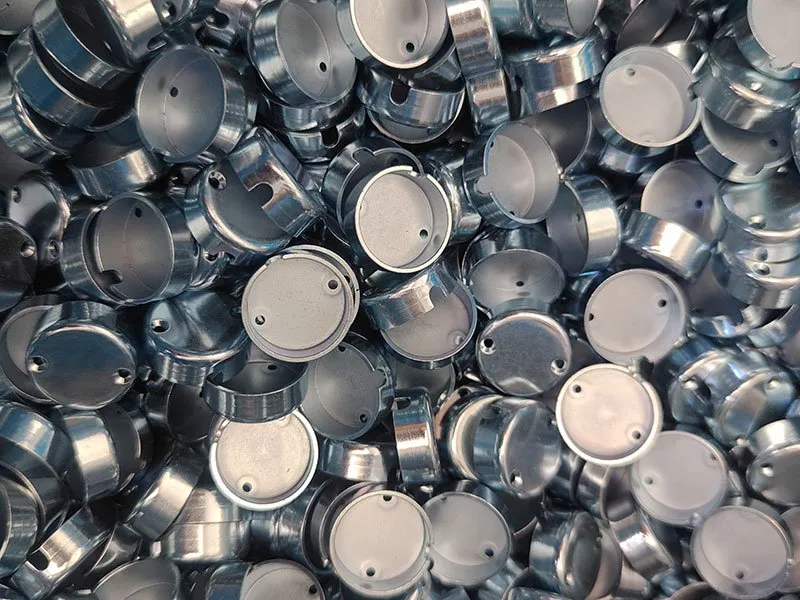

Part Types We Produce for Robotics
- Stepper / PM motor claw poles and claw-pole stators
- DC motor end caps, end covers and motor housings
- Thin-wall rotor and magnetic isolation sleeves
- Anti-vibration bushings and bonded-collar metal rings
- Frames, brackets and mounting plates for actuators
- Power-module base plates for robot controllers
Engineering & Quality Considerations
- Tolerances for automated assembly: ID, OD and overall height are held so parts feed through automated assembly and packaging without drift across the run.
- Thin-wall deep drawing: wall-thickness consistency and concentricity are controlled in the tool, which matters for sleeves that separate rotors from stators.
- Fine blanking and edge quality for parts with functional bright bands, flatness and burr-free edges.
- Plating and passivation (Zn-Fe, Zn-Ni, nickel) coordinated in-house for corrosion and wear requirements.
Frequently Asked Questions
Which robotics parts can Balford stamp?
Motor claw poles and claw-pole stators (SECC), DC motor end caps and covers, thin-wall rotor sleeves, magnetic isolation sleeves, anti-vibration bushings, actuator frames and brackets, and copper base plates for controller power modules.
Can you hold tight tolerances on stamped motor parts?
Yes. Claw poles that feed fully automated assembly lines hold tight ID, OD and height tolerances with no drift across the run; inner-hole perpendicularity relative to the claw piece is controlled in the tooling and process.
What materials do you recommend for motor cores?
SECC (electro-galvanized steel) is common for claw poles and magnetic parts; DC01/DC04 and 1008 CRS are used for housings, frames and brackets, and stainless steel where corrosion resistance is required.
Do you support PPAP and FAI documentation?
Yes — documentation follows ISO 9001:2015 with IATF 16949-aligned controls; PPAP-aligned documentation, FAI reports and material certifications are available on request.
What volumes do you support?
Progressive die tooling supports both development builds and steady OEM production volumes; the same tooling philosophy keeps per-part cost predictable as volumes scale.
Have a Drawing or 3D Model?
Send us your 2D drawing or STEP/IGES model. We will review material, tolerances, forming requirements and production volume before quoting.
Robotics and UAV motor parts depend on custom dies — Balford designs that tooling in-house.
Robot and UAV motor housings are formed on presses up to 350 t — see the equipment list.