
What are the mold processing requirements for metal stamping parts? What factors affect the service life of stamping dies? Below, the team at Zhejiang Baifudu Electromechanical will give you an overview.
A die used in stamping is referred to as a stamping die. A stamping die is a specialized tool used to batch-process materials (metal or non-metal) into the required stamping parts. Stamping dies are the key to stamping operations. Without a die that meets the requirements, mass stamping production is difficult to carry out; without advanced dies, advanced stamping processes cannot be realized. There are three essential elements for stamping parts. Only when they are combined with each other can stamping parts be formed.
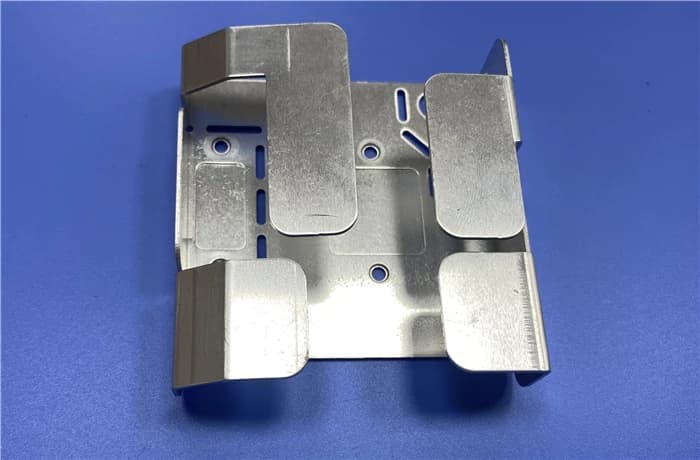
Stamping parts are primarily formed by applying pressure through a press, using metal or non-metal sheets. Their main characteristics are as follows:
I. Main Characteristics of Stamping Parts
(1) Stamping parts are produced through stamping with minimal material consumption. The parts are lightweight, have good rigidity, and the internal metal structure is improved after plastic deformation, significantly enhancing the strength of the stamped parts.
(2) Stamping parts have high dimensional accuracy, uniform dimensions consistent with the die, and good interchangeability. General assembly and usage requirements can be met without the need for machining.
(3) During stamping, since the material surface is not damaged, the surface quality is good, and the appearance is smooth and aesthetically pleasing, which facilitates surface treatments such as painting, electroplating, and phosphating.
The dies used for stamping parts are typically specialized. Sometimes, a complex part requires several sets of dies for processing and forming. Furthermore, die manufacturing requires high precision and is a technology-intensive product. Therefore, only through mass production of stamping parts can the advantages of stamping be fully realized, leading to better economic benefits. However, there are also some issues and shortcomings in the stamping process. These mainly manifest as noise and vibration during stamping, and operator accidents frequently occur. Nevertheless, these problems are not entirely caused by the stamping process and the dies themselves, but are mainly due to traditional stamping equipment and outdated manual operations.
In the stamping production process at a metal stamping factory, our dies also have a service life as they undergo wear and tear from repeated processing. So, what are the main factors affecting the service life of stamping dies?
II. Main Factors Affecting the Service Life of Stamping Dies
1. Deformation: During use, the punch and die of a stamping die may undergo shape deformation, causing changes in the geometric shape of the processed product parts, thereby affecting the dimensional accuracy and shape requirements of the processed parts. This situation is the opposite of fracture. The main causes are insufficient quenching hardness of the punch and die during heat treatment, or the hardened layer being too shallow, leading to geometric deformation of the punch and die under stress.
2. Fracture: The punch and die of a stamping die may suddenly be damaged, break, or crack during use. Since the die is the part that bears the greatest stamping pressure during punching operations, the punch often experiences fracture or similar phenomena during the stamping process. The main causes include improper heat treatment (hardened layer too deep) and excessively small design clearances, which can lead to punch and die damage, breakage, and fracture. Punch and die fractures may be partial damage that can be repaired and reused, or they may be severe or complete damage that cannot be repaired, requiring the design of new punches or dies according to the drawings.
3. Wear: Wear is caused by long-term, frequent friction between the punch, die, and the processed material. Therefore, prolonged friction between the punch and die and the processed material during extensive stamping operations can result in excessive burrs on stamped parts (due to excessive clearance) or insufficient clearance between the punch and die, which are the main causes of punch and die wear. For example, the cutting edges of the punch and die may become dull, and the corners may become rounded.
4. Galling: Uneven clearance adjustment and assembly of the punch and die can cause the adjacent edges of the punch and die to bite into each other, resulting in damage to the cutting edges. If the punch and die are misaligned during assembly, the clearance is uneven, and when installing dies without guides, improper clearance adjustment can cause the punch and die to gall and damage each other.
The above covers the relevant content of hardware stamping die processing. Due to the assurance provided by dies in hardware stamping processing, the dimensions and shapes of hardware stamping parts can achieve micron-level precision, and in many cases, the surface quality of stamped parts is not compromised, making the characteristics of hardware stamping parts stable and interchangeable. We hope the above content is helpful to readers.