
Metal stamping is an advanced metal processing method that can be divided into cold stamping and hot stamping. Cold stamping does not require heating of the material and can be performed at room temperature, making it more convenient. Stamping is based on the plastic deformation of metal, using dies, blanking dies, presses, and other equipment to obtain parts of the required shape and size. So, how can damage be avoided during hardware stamping die processing? How can finished stamped parts be inspected? Let's find out with the editors of Zhejiang Baifudu Electromechanical!
Stamping is a process that uses press dies to deform or fracture metal materials such as iron, aluminum, and copper, thereby obtaining parts with specific shapes and dimensions. Today, hardware stamped parts are widely used in various fields of our daily lives, including electronic devices, automotive components, decorative materials, and more. Let's take a look at how to avoid damaging metal stamped parts.
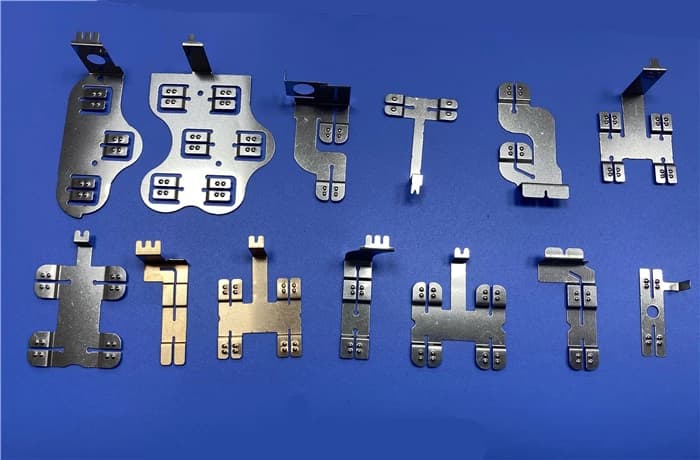
I. How to avoid damage is as follows:
1. Sliding hinges should not use aluminum alloy materials; stainless steel materials should be used instead.
2. For sliding windows wider than 1 meter, or doors and windows with double-glazed glass, double pulleys or movable pulleys should be installed.
3. Hardware fittings should include end stops and door/window locks. Handles and other components should be installed after the window and door frames are in place, ensuring accurate positioning and smooth operation.
4. When using fastening screws to install hardware, a metal backing plate must be used, with a thickness at least twice the thread pitch of the fastener. It cannot be used to fix plastic profiles, and non-metal backing plates are not permitted.
5. The types, specifications, and performance of the hardware fittings used should comply with current national standards and relevant specifications, and should be matched with the selected plastic-steel doors and windows.
6. After installation, attention should be paid to maintenance to avoid corrosion. During daily use, close and open gently to prevent damage from forceful operation.
How to inspect metal stamped parts? The Rockwell hardness tester is used for hardness inspection of metal stamped parts. For example, small or irregularly shaped stamped parts with very small test surfaces cannot be tested using a standard bench-top Rockwell hardness tester.
The PHP series Rockwell hardness tester is particularly suitable for hardness testing of such stampings. Aluminum alloy stampings are common parts in the metal processing and mechanical manufacturing fields. The processing of stampings is a method that uses dies to separate or form metal sheets and strips. It has a wide range of applications.
The main purpose of hardness inspection for blanked parts is to determine whether the annealing degree of the metal sheet is suitable for subsequent stamping processing. In the processing of different types of stampings, there are requirements for sheets of different hardness grades. The Webster hardness tester can be used to inspect the processing condition of stampings. When the data exceeds 13mm, the Barcol hardness tester can be used as a substitute. For pure aluminum or low-hardness aluminum alloy sheets, the Barcol hardness tester can be used.
In the stamping industry, stamping is sometimes referred to as sheet metal forming, but there is a slight difference. What we call sheet metal molding is a forming method that plasticizes raw materials such as thin sheets, collectively referred to as sheet metal forming. At this time, deformation in the thickness direction of the sheet is generally ignored.
2. Optimizing the planning method for metal stampings.
Reasonable die planning is the foundation for improving die durability. To improve the durability of metal stamping dies, unreasonable factors in product forming should be fed back in a timely manner during die planning. If a small-hole metal die is intended for punching, a method of adding guide bushings should be adopted to strengthen the strength of the punch needle in the small-hole die. In addition, the guide pin should be as short as possible. The reduced length equals the increased strength.
3. Performing appropriate heat treatment on hardware blanking parts.
High-quality metal stamping dies, together with the selection of sheets, also require reasonable heat treatment of the die plates to improve the durability of the metal stamping dies. Examples include quenching and vacuum heat treatment.
4. Reasonable use of metal stamping dies can ensure machining accuracy.
In terms of metal die service life, die accuracy has a significant impact on die life. Before making the die, the die must first be installed. Die debugging requires positioning all holes and installing the die before production. During die installation, the flatness of the die and the fixed plate support surface, as well as the uniformity of the distance between the metal die and the guide bushing, have strict requirements on the guiding accuracy of the guide pillar. The higher the manufacturing and installation accuracy, the more the accuracy of the processed parts will be guaranteed, and the higher the durability of the metal die will be.
5. Correctly selecting the punching amount.
To improve the durability of stamping dies for metal parts, dies with high precision and high rigidity should be selected. A stamping rate of 30% or more is recommended; ideally, a servo-controlled press should be used. The servo acts like a transformer, providing constant current and stabilizing voltage, which not only protects the machine's durability but also extends the service life of the die.
6. Proper use and protection of the die.
To enhance the durability of metal stamping dies, operators must regularly protect and maintain the dies under reasonable operating conditions. It is best to perform daily maintenance and repair on metal stamping dies, which can effectively prevent issues from arising.
Based on the above content related to metal stamping die processing, metal stamping parts are lightweight with satisfactory strength and rigidity. They can be processed into parts of various shapes and sizes according to different applications and materials, offering a wider range of uses. It is hoped that the above content will be helpful to readers.