
This is a metal stamping part composed of automotive components. Some of these punches directly produce automotive parts after stamping, while others require additional processes such as welding, painting, or machining after stamping. So how do you choose the raw materials for processing automotive stamping parts? What are the common processing defects in stamped parts?
Selection of raw materials for automotive stamping parts:
For material selection, first choose metal materials with different mechanical properties based on the variety and application characteristics of automotive stamping parts, aiming to ensure product quality while saving materials.
When processing materials for automotive stamping parts, the following principles should be followed:
(1) Material selection must first meet the functional requirements of automotive components;
(2) The selected material should have good processing performance;
(3) The selected raw material should have good economic efficiency.
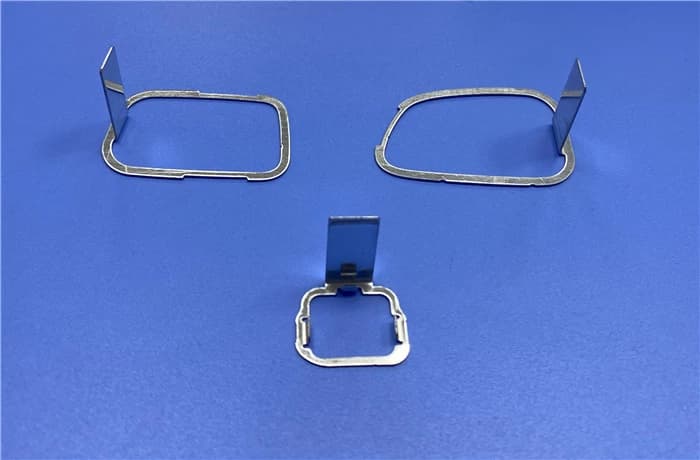
In the production of automotive stamping parts, cold stamping processes are widely used, meeting the industry's requirements for multiple varieties and production needs. Medium and heavy vehicles, large surface parts such as body outer panels, and some load-bearing and supporting parts like frames and carriages are all automotive stamping parts. Cold stamped parts use steel plates and steel strip fasteners, accounting for 72.6% of the total assembled steel. The material for cold stamping dies is closely related to the production of automotive stamping parts. The quality of the material not only determines product performance but also directly affects the process planning of automotive stamping parts, influencing product quality, aging, service life, and production structure. Therefore, selecting the appropriate raw material is a crucial factor and a very difficult and complex task.
Generally, the automotive stamping parts we use are oriented towards aesthetics, applicability, and economy. However, when evaluating the quality of stamping parts, we should place more emphasis on the number of processes involved. Additionally, reducing the number of processes and simplifying the operation steps during stamping are also challenging issues. Furthermore, when assessing the quality of automotive accessories, the layout of the stamping parts can also be used for identification.
Of course, when judging the quality of a small number of automotive stamping parts, certain standards are used. During the application process, it is difficult to describe in words, but there are indeed some quality judgment standards or criteria that exist.
Common defects in automotive stamping materials include burrs, wood surface warping, dimensional deviations, etc.
For automotive connecting rod stampings, it is generally difficult to avoid producing burrs of varying grades, but by improving the process sequence of the formed product and optimizing the stamping conditions, burrs can be reduced.
This is a burr, and it is a key point:
1.1 Clearance
Excessive, insufficient, or uneven clearance in stamping dies can cause burrs. The main reasons for excessive, insufficient, or uneven clearance are as follows:
-Die manufacturing errors: Die components are not machined according to the drawings, poor parallelism of the base plate, etc.
Assembly errors: Large guide rail clearance, poor assembly of male and female dies, etc.
Poor press accuracy: For example, excessive clearance in the press guide rails, poor parallelism between the slide block bottom and the worktable surface, or poor perpendicularity between the slide stroke and the press worktable surface, and insufficient rigidity of the worktable.
Installation errors: For example, the upper and lower base plate surfaces of the die are not cleaned during installation, incorrect fastening techniques for the upper die of large dies, or misalignment of the upper and lower dies during installation (especially for dies without guides), causing the action to be partially skewed.
In the e-die layout, the die head and partial surface have insufficient rigidity, causing unbalanced force in automotive stampings.
The steel葫芦 has a large curvature - the steel plate is not flat.
1.2 The cutting edge is slow.
Dull or stuck cutting edges can produce burrs. Factors affecting edge passivation include:
Poor material and surface treatment of the die punch and die button, resulting in poor wear resistance.
Poor layout, insufficient rigidity, and tight clamping.
Lubrication is not timely during operation, leading to rapid wear.
d cannot be immediately ground to a sharp edge.
The above is related to the processing of automotive stampings. There are many types of automotive stampings, so the selection of stampings also has specific specifications. Moreover, common defects in automotive stamping processing should be handled with good methods. I hope the above can be helpful to readers.