
I. Analysis of Causes of Bursting in Metal Stamping Dies
1. Unclean Blanking
During production, there is no demagnetization treatment and no demagnetization phenomenon; during production, there are broken pins, springs, and other card materials; when assembling the die, there is no leakage of waste, no blocked rolling waste, and no blocked foot pads, which is a common phenomenon. If attention is not paid during the assembly process, if there are too many blanking holes or die jamming, it is easy to cause air leakage, rolling blockage, and foot blockage during assembly. This is a common phenomenon. If attention is not paid during assembly, it is easy to occur. If there are too many blanking holes or the die has spacers, this situation is prone to happen.
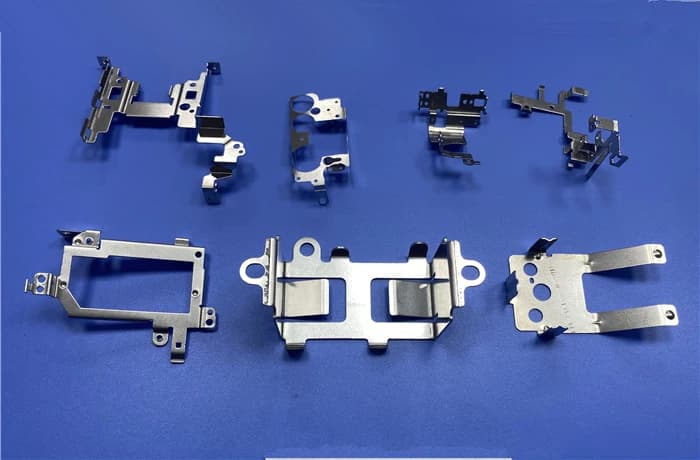
2. Design Process.
Insufficient die strength, too close blade edge spacing, unreasonable die structure, insufficient number of template plates, and lack of backing plates and foot pads.
3. Heat Treatment: Improper quenching and tempering process leads to deformation.
Experimental results show that the hot working quality of the die has a significant impact on the performance and service life of the die. Through analysis and statistics of die failure causes, it can be seen that die failure accidents caused by improper heat treatment account for approximately 40%.
4. Inappropriate Wire Cutting.
Improper handling of wire cutting and slit joint treatment has no effect on the sharp corners and the deteriorated layer of wire cutting. The die blade is mainly processed by wire cutting. During the wire cutting process, due to thermal effects and electrolysis, a deteriorated layer of a certain thickness is produced on the die surface, resulting in reduced surface hardness, micro-cracks, and other issues, making wire-cut stamping dies prone to early wear, directly affecting the maintenance of blanking clearance and causing the blade edge to easily chip, thereby reducing die life. Therefore, during wire cutting, reasonable electrical parameters should be selected to minimize the depth of the deteriorated layer as much as possible.
5. Selection of Punch Press Equipment.
The punching machine has a large tonnage, but the stamping force is insufficient, and the adjustment under the die is too deep. The precision and rigidity of the stamping press are very important to its service life. High precision and good rigidity greatly extend the service life of the die. For example: for composite silicon steel die material Crl2MoV, when used on an ordinary open-type press, the average service life is 10,000 to 30,000 strokes, whereas with a new precision stamping press, the die's re-grinding life can reach 60,000 to 120,000 strokes.
In addition, the production awareness of metal stamping operators is also very important. If positioning is not accurate, the air blow gun is not used, and production continues even when the template is cracked. So how should stamping die processing materials be selected?
2. How to select stamping die processing materials?
1. Production batch: When stamping parts are produced in large quantities, the punch and die materials should be high-quality, wear-resistant die steel. Other process structural components and auxiliary structural components of the die should also be improved. When the batch is small, the performance requirements of the materials can be reduced to lower costs.
2. Performance of the stamped parts and their service conditions: When the material being stamped is harder or has greater deformation resistance, the punch and die should be made of materials with good wear resistance and high strength. Aluminum bronze dies are suitable for drawing stainless steel due to their better anti-adhesion properties. However, guide pin bushings require wear resistance and good toughness, so low-carbon steel with carburizing and hardening is often used. The main disadvantage of carbon tool steel is its poor hardenability; when the cross-section size of the stamped part is large, the hardness at the center after quenching remains low. However, when used in multi-stroke presses, its good impact resistance becomes an advantage. For fixed plates and stripper plates, not only sufficient strength is required, but also minimal deformation during operation. In addition, the performance of parts can be improved through cold treatment, deep cryogenic treatment, vacuum treatment, and surface strengthening. For cold extrusion dies with harsh working environments for punches and dies, a die steel with comprehensive mechanical properties such as sufficient hardness, strength, toughness, and wear resistance should be selected, while also possessing certain red hardness and thermal fatigue strength.
3. Material properties: Consider the cold and heat treatment properties of the material and the current status of the factory.
The above is related to metal stamping dies and material selection. In metal processing, there are many processing methods used. In daily die processing and metal stamping part production, attention should also be paid to product quality, as well as whether there are errors in actual production, to avoid defects or unqualified quality in metal stamping products. I hope this article is helpful to readers.