
The mold has a very important influence on the processing quality of automotive stampings. If the cutting edge of the stamping die cracks, problems are likely to occur on the Z-axis during use, which can affect the hardness of the mold raw material and the normal operation of the operator. What problems can occur with automotive stamping dies? How can folding in automotive stampings be controlled?
During the processing of automotive stampings, die galling mainly occurs in processes such as forming and drawing. Based on the location of the galling on the part, the corresponding position should be identified, and an oilstone should be used to polish and remove burrs, but care should be taken to keep the fillets uniform.
Burrs on automotive stampings are usually caused by excessive die clearance. Adjustments can be made based on the mold type and clearance size to ensure that the part dimensions remain unchanged before and after repair, while also resolving the burr issue.
Deformation of blanking dies during production, especially for visible parts, has a significant impact on product quality. This can generally be addressed by increasing the blank holder force, applying targeted solutions.
During punching, scrap blocking in the die holes of custom automotive stamping dies may be due to an unsmooth scrap chute, a tapered chute, or scrap not being cleared in a timely manner. Based on these three points, cleaning and improvements can be carried out.
When designing automotive stamping products, they should meet usage and technical performance requirements and facilitate die assembly.
Automotive stampings must adopt solutions that improve material utilization and reduce material waste, striving for zero scrap or minimal scrap in stamping parts.
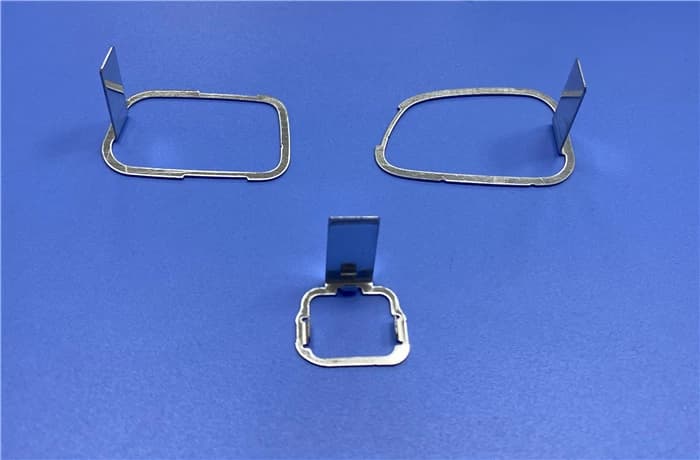
Design a simple form with a reasonable structure and simple, feasible processes, avoiding the repeated use of other processing methods, which is beneficial for stamping; try to use automatic stamping to improve production efficiency.
For automatic stamping parts, make full use of existing equipment and processes for processing, which is beneficial for improving die life.
The automotive stamping industry uses a large number of cold stamping processes to meet the requirements of multi-variety, high-volume production. For medium-sized automobiles, most cover panels, such as body outer panels, as well as some load-bearing and support components, such as frames and automotive stampings, are produced this way.
Automotive stampings indicate that the steel used for cold stamping is mainly steel plates and strips, accounting for 72.6% of the entire vehicle. Cold stamping materials are closely related to the processing of automotive stampings. The quality of the material not only determines the performance of the product, but also directly affects product quality and cost. Therefore, the rational selection of materials is an important and complex task.
I. Measures for Controlling Wrinkling in Vehicle Stampings
1. Inspect the wrinkling condition. When wrinkles are uniformly generated around the part, it should be determined that the blank holder force is insufficient, and the wrinkles can be eliminated by gradually increasing the blank holder force. When drawing conical and hemispherical parts, draw beads should be added to increase the tensile stress within the blank diameter and eliminate wrinkles. Adopt the principle of "loose on the outside, tight on the inside" to resolve the issue of loose inside and tight outside.
2. For lubricating oil, brushing operations should be carried out in accordance with the systematic requirements of the operating procedures to ensure that the brushing and the brushing position are correct, thereby avoiding wrinkling.
3. On the premise of not affecting the overall vehicle requirements, replace the material of parts with overly soft blanks to ensure part quality and prevent wrinkling.
4. Improve positioning, and add a pre-bending process when necessary to ensure that the stamping parts do not deviate. Adjust the shape of the blank holder surface to ensure forming quality and prevent uneven material flow caused by an unchanged blank holder surface shape.
5. For incorrect punching directions, use simulation software to conduct process analysis of the stamping process during the initial design phase to ensure the stamping direction. When there are certain quality requirements for the stamping, the die needs to be improved.
The above is the relevant content regarding dies for automotive stamping processing. During the stamping process, dies must withstand loads such as impact, vibration, friction, high pressure, as well as tensile and bending torque. Even when working under high temperatures, the working environment is complex and prone to wear, fatigue, fracture, deformation, and other phenomena. Therefore, the material requirements for dies during operation are higher than those for ordinary parts. It is hoped that the above content can be helpful to readers.