
When the material is stretched, the surrounding edges experience excessive tangential stress, causing material instability and resulting in uneven wrinkles along the edges of the product, known as wrinkling. Severe wrinkling can also make it difficult for the material to pass through the clearance between the die and punch during stretching, increasing the drawing force and potentially leading to cracking.
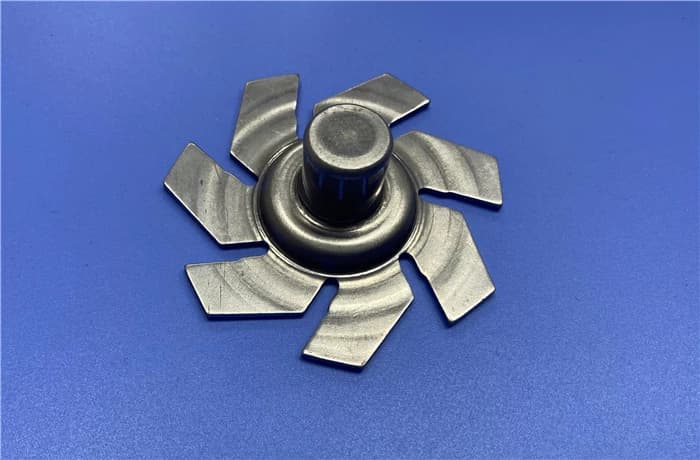
There are many causes of wrinkling in drawn parts, mainly including the following: the blank being drawn is not thick enough, so the pressure it can withstand is naturally lower, making it prone to wrinkling during the drawing process; the elongation coefficient is not selected according to the grain direction of each blank, making the degree of deformation difficult to control, and if not controlled properly, deformation will occur; severe wear on the blank holder prevents it from applying uniform pressure to the blank, resulting in uneven pressure distribution and wrinkling.
The thickness of the blank to be drawn should be relatively thicker so that it can withstand the corresponding pressure during drawing, making it less prone to deformation and wrinkling; an appropriate drawing coefficient should be selected to match the material properties of the blank, making the degree of deformation easy to control; the blank holder ring needs to be frequently replaced or repaired to ensure the blank receives uniform pressure, reducing the likelihood of wrinkling.
1. How to remove wrinkles when they appear on drawn parts?
1. Extensive production practice has proven that the main causes of wrinkling in drawn parts are material accumulation during the drawing process and excessive local material flow speed. When designing the actual solution, the corresponding mechanisms of the die should be adjusted considering the above factors, which can achieve good results.
2. The method to prevent wrinkling is to determine whether the punch can properly hold the material during drawing, thereby establishing the correct sheet metal flow speed. During the drawing process, if the sheet metal flows too quickly during stamping, it will cause wrinkling; on the other hand, if the sheet metal flows too slowly, it may lead to cracking of the stamped part.
3. When wrinkles appear uniformly around the drawn part, it should be determined that the blank holding force is insufficient.
4. When drawing conical and hemispherical parts, most of the material is in a suspended state at the beginning of the drawing process. Since this can easily cause side wall wrinkling, in addition to increasing the blank holder force, draw beads should be added to increase the tensile stress within the sheet.
5. If the die radius is too large, the bending resistance generated when the blank flows into the die and bends through the die radius will be smaller. The better the bending resistance, the more prone to wrinkling. If the die radius is small, the bending resistance generated by bending deformation is greater, making it less prone to wrinkling, but it can easily cause cracking and scratching of the part.
2. Maintenance and Repair Precautions for Drawn Parts
1. Before using drawn parts, they should be strictly inspected and cleaned of dirt. Carefully check whether the guide bushings and die lubrication of the drawn stamping parts are in good condition.
2. According to the die installation procedure, mount the punch and die on the turntable, ensuring that the punch and die for the drawn stamping parts are oriented consistently. Special attention is required for parts with directional requirements (non-circular and square shapes) to prevent incorrect installation or reversed mounting.
3. Regularly inspect the turntable and die mounting base of the press to ensure the concentricity and precision of the upper and lower turntables.
4. When installing the die, the operator should use tools made of softer metals (such as copper or aluminum) to prevent damage to the drawn stamping parts from dropping during installation.
5. When the cutting edges of the punch and die for drawing parts become worn, stop using them immediately and regrind them in a timely manner. Otherwise, the wear on the die edges will rapidly increase, accelerating die wear and reducing the quality of the stamped parts and the die's service life.
6. To ensure the service life of drawn parts, the die springs should also be replaced periodically to prevent spring fatigue damage that could affect the service life of the drawn stamping parts.
The above covers the causes and solutions for wrinkling in drawn parts. During the production of drawn parts, attention should be paid to ensuring that the strip material is fed under normal working conditions when using presses or stamping dies, preventing the strip from deviating from the correct position or being fed with incorrect clearances. Hopefully, the above information is helpful to the readers.