
In conventional deep drawing operations, any single step can affect the quality of the drawn parts. Therefore, every daily operation process requires experienced technical personnel, so that any problems can be resolved promptly. For example, in many manufacturing processes, it is found that the dies for drawn parts are prone to scoring/galling. How should we handle this? Let the drawn parts manufacturer share some relevant knowledge: How to handle common problems in drawn parts processing?
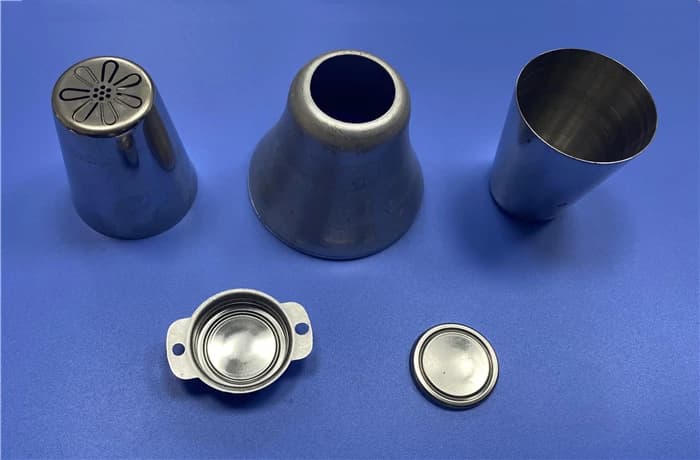
For the above issue, we should reduce adhesive wear and change the characteristics of the contact pair before achieving a solution. Let's briefly analyze this.
1. Regarding the workpiece material: In terms of raw material, after surface treatment—such as phosphating, spray coating, or other surface treatments—a non-metallic film is formed on the surface of the forming material. This method is usually costly, requiring additional production equipment and added production steps. Although this method can sometimes produce some effect, it is rarely used in actual production.
2. Between the metal part and the die, adding a film such as PVC between the die and the forming material can sometimes solve the workpiece scoring problem. In terms of production line organization, continuous film supply, and periodic production, a layer of film needs to be added each time a workpiece is produced, which affects production speed. This method is usually costly and also generates a large amount of waste. For small-batch production of large workpieces, this method is acceptable. When certain forming loads are low, adding lubricating oil or an EP (extreme pressure) additive lubricant can solve the workpiece scoring problem.
3. Modifying the die convexity, the die material, or the punch convexity/concavity, surface treatment of the punch and die, or selecting appropriate die materials can change the contact characteristics between the drawn material and the punch/die. From a practical standpoint, this is an economical and practical treatment method and is currently widely applied. In summary, there are many methods to handle scoring on drawn parts and on the surfaces of punches and dies. The specific method should be based on the workpiece, the magnitude of the load, the production batch size, the type of material being processed, and other factors.
The workpiece shapes of drawn parts are complex and varied, with high requirements for dimensional accuracy. The processed products are flush with the finished products, and the cut surfaces are very flat and smooth. Compared with other processing techniques, it can machine high-precision gear blanking parts with very small modules, and the drawn parts have clear contours and small concave angles.
During processing, drawn parts mainly rely on press force to stamp metal or non-metal materials. In the processing of drawn parts, the precision of the workpiece is very high, reaching micron levels. Compared with other processed parts, this product has obvious advantages: light, thin, uniformly distributed, and pressure-resistant. During processing, mass production can be carried out, shortening processing time, and forming in one step without requiring additional machining. This product is mainly used in automotive handbrakes, cars, motorcycles, and other products, and is an economical and fast mechanical and electrical product component.
Next, we will introduce some issues related to drawn parts so that you can clearly understand them through learning. In this way, you can add some professional knowledge to the products on this website.
1. Blanking-drawing: Does it apply to shallow drawn parts or deep drawn parts?
Blanking-drawing is suitable for shallow drawn parts, because the steel plate must be clamped during blanking, and the steel plate must also be clamped during deep drawing. Therefore, based on this, there will be the corresponding theory mentioned above. Moreover, this is beyond doubt.
2. How to perform thread rolling on a tie rod?
In this case, according to Balford Electromechanical, a manufacturer of stamped parts, the ordinary thread rolling method cannot be used because it is not applicable. Instead, a mandrel should first be inserted through the tie rod, and then the thread rolling operation can be carried out, thereby completing the task smoothly.
3. How to prevent scratching issues on tie rods?
To prevent scratching issues, we can adopt certain methods, and there are several aspects that should be noted. The main points are as follows:
First, the appearance of the die used should be smooth, and it should remain smooth during the drawing process;
Second, the hardness of the die material should not be too low.
Third, it is necessary to clean the drawn parts. There should be no dust or dirt on them.