
Stamping drawing is a common forming process, also frequently seen in the industrial sector. Drawing forming is a stamping method that uses a die to form a flat blank into an open hollow part. As one of the main processes for stamping parts, drawing is widely applied. Through the drawing process, thin-walled parts with irregular shapes such as cylindrical, rectangular, stepped, spherical, conical, and parabolic shapes can be produced. If combined with other stamping processes, parts with more complex shapes can be manufactured. So what are the types of metal stamping drawn parts?
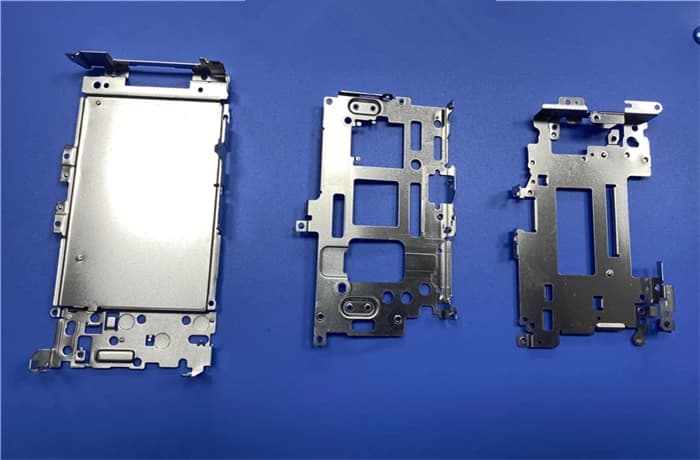
Stamping equipment is used for the drawing and forming of products, including drawing, redrawing, reverse drawing, and ironing.
Drawing: Using a blank holder device and the punch force, part or all of a flat sheet is drawn into the die cavity to form a container with a bottom. The side walls of the container are parallel to the drawing direction, while the drawing of conical (or pyramidal) containers, hemispherical containers, and parabolic containers also involves stretch forming.
Redrawing: For deep-drawn products that cannot be completed in a single drawing operation, the formed product needs to be drawn again to increase the depth of the container.
Reverse drawing: The workpiece from the previous drawing operation is drawn in the reverse direction, turning the inner side into the outer side, thereby reducing the outer diameter.
Ironing: The formed container is squeezed through a die cavity slightly smaller than its outer diameter using a press, making the bottomed container smaller in outer diameter and thinner in wall thickness, which not only eliminates wall thickness variations but also smooths the container surface.
When using stamping equipment for hardware stamping and drawing, the following 16 types are included:
1. Cylindrical drawing
Drawing of cylindrical products with a flange. Both the flange and the bottom are flat shapes, the cylindrical side wall is axisymmetric, deformation is uniformly distributed on the same circumference, and the blank on the flange undergoes drawing deformation.
2. Elliptical drawing
The deformation of the blank on the flange is tensile deformation, but the amount and ratio of deformation vary correspondingly along the contour shape. The greater the curvature, the greater the plastic deformation of the blank; conversely, the smaller the curvature, the smaller the plastic deformation of the blank.
3. Rectangular Deep Drawing
Low rectangular parts formed in a single drawing operation. During drawing, the drawing resistance at the corner areas of the flange deformation zone is greater than that at the straight edge areas, and the degree of deformation at the corners is greater than that at the straight edges.
4. Gabled (Roof-shaped) Deep Drawing
When the side wall of the stamped part is an inclined surface, the side wall remains unsupported and does not contact the die during the stamping process, only making contact at the end of forming. The deformation characteristics of different areas of the side wall during forming are not entirely identical.
5. Dome-shaped Deep Drawing
The deformation of the blank during the forming of a dome-shaped cover plate is not simple tensile deformation, but rather a compound forming process involving both stretching and bulging deformation. The deformation on the blank holder surface is tensile deformation (radial tensile stress, tangential compressive stress), while the deformation of the blank inside the contour (especially in the central region) is bulging deformation (radial and tangential tensile stresses).
6. Hemispherical Deep Drawing with Flange
During the drawing of spherical parts, the blank makes only partial contact with the spherical top of the punch, while the remaining large portion is in a free, unsupported state. Therefore, the main process issues for this type of spherical part are severe thinning at the local contact area or instability and wrinkling in the curved surface region.
7. Flange Deep Drawing
The flange portion of the drawn product is formed using shallow drawing. Its stress-strain behavior is similar to that of compression flanging. Due to the presence of tangential compressive stress, wrinkling is prone to occur, so the forming limit is mainly restricted by compression wrinkling.
8. Edge Drawing
The flange portion of the product drawn in the previous operation is subjected to angular re-drawing, which requires the material to have good plasticity.
9. Deep Drawing
Products that exceed the drawing limit require two or more drawing operations to complete. The product drawn in the depth direction in the previous station is re-drawn in the depth direction. A wide-flange drawn part is drawn to the required flange diameter in the first drawing operation, and the flange diameter remains unchanged in subsequent drawing operations.
10. Conical Drawing
For deep conical parts with H/D>0.8 and α=10°~30°, due to the large depth, the blank undergoes a significant degree of deformation. Since only the contact area between the blank and the punch can easily transmit forming force, it is prone to excessive localized thinning or even cracking of the blank, requiring multiple transitional steps to gradually form the shape. The stepped drawing method first draws the blank into a stepped transitional part, whose stepped shape is tangent to the inner shape of the conical part, and finally forms the cone. The number of drawing operations and the process for the stepped transitional part are the same as those for stepped cylindrical parts.
11. Rectangular Re-drawing
The deformation of tall rectangular parts formed by multiple drawing operations is not only different from the drawing of deep cylindrical parts, but also significantly different from low box-shaped parts. When processing tall rectangular boxes on a multi-station automatic transfer press, the shape and dimensions of the part change with the drawing height during the multiple drawing processes.
12. Surface Forming
Curved surface stretch forming is a stamping method that shrinks the outer flange portion and elongates the inner flange portion of a flat metal blank to produce a hollow product with a non-straight wall and non-flat bottom curved surface shape.
13. Stepped Drawing
The initial drawn product on the left undergoes redrawing to form a stepped bottom on the right. The deep portion deforms early in the drawing process, while the shallow depth drawing deforms later in the drawing process. The side walls at the stepped transition are prone to induced shear stress and deformation.
14. Reverse Drawing Process
Reverse drawing of a workpiece that has been drawn in a previous operation is a type of redrawing. Reverse drawing can increase radial tensile stress and is highly effective in preventing wrinkling. It is also possible to increase the drawing coefficient of the redrawing process.
15. Ironing (Wall Thinning) Drawing
Unlike conventional drawing, ironing primarily changes the wall thickness of the drawn part during the drawing process. The clearance between the punch and die is smaller than the blank thickness, causing the straight wall of the blank to be subjected to significant uniform compressive stress as it passes through the clearance. When the wall thickness is reduced during drawing, variations in the container wall thickness are eliminated, the surface smoothness of the container is increased, and precision and strength are improved.
16. Sheet Metal Drawing
Sheet metal products are stamped parts with complex surface shapes. In the drawing operation, the blank deformation is complex, and its forming nature is not simple stretch forming, but rather a compound forming process that simultaneously involves both drawing and stretching (bulging).