
Metal stamping die molds are single-piece production. The key to metal stamping die assembly is how to ensure that the relative positions of the punch, die, and various related components can work reasonably during die closing, and perform stamping to meet product requirements. Below, the editor of Zhejiang Baifudu Electromechanical shares the assembly principles and technical requirements for hardware stamping dies!
All parts used in metal stamping processing assembly must meet the assembly process requirements specified for each part; for example, the relative position dimensional accuracy between multiple punch fixed plates and various shaped holes, as well as the step distance accuracy, must meet the requirements of the die and stripper plate. The bolt and pin holes on the backing plate should be laid out according to the drawing dimensions, quenched, and the upper and lower surfaces should be strictly ground flat. The integral die installed on the upper and lower die bases, in addition to all shaped holes being machined to meet the drawing requirements, also needs bolt holes and pin holes machined, and can only be put into assembly after heat treatment and finishing. The die set and guide plate that must be connected and fixed, the screw holes and pin holes on the guide plate should be drilled and reamed using the corresponding holes on the die during assembly; although the types and structural characteristics of hardware blanking dies are not all the same, and the assembly methods and installation sequences adopted are also different, the assembly principles that should be followed are as follows.
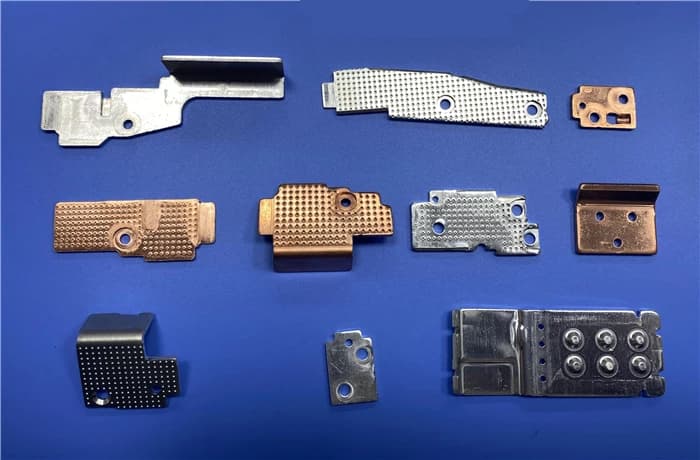
Some components that make up the die entity are machined to dimensions and tolerances according to the dimensions and tolerances marked on the drawings during the manufacturing process (such as blanking grooves, piercing punches, guide pillars, guide bushes, die shanks, etc.). These parts are usually installed directly, while some parts only have some dimensions that can be processed according to the drawings during manufacturing. It is necessary to match the relevant dimensions. Some need to be mixed or matched before assembly, and others need to be matched during assembly. The dimensions marked in the drawing are for reference only, such as the die base guide bush or guide pillar fixing holes on multiple punch fixed plates. The bolt holes and pin holes of the plates that need to be connected, etc.).
Therefore, for hardware stamping die assembly, centralized assembly is suitable. In the assembly process, repair methods and adjustment assembly methods are often used to ensure assembly accuracy. In this way, higher assembly accuracy can be achieved, reducing the machining standards of parts, thereby meeting the accuracy requirements of parts. The technical requirements for metal stamping die assembly are as follows:
1. The accuracy of the die set should comply with the standards specified in JB/T8050-1999 "Technical Conditions for Stamping Die Sets" (JB/T8071-1995) for relevant stamping die accuracy testing. The die height should meet the standards specified in the drawing.
2. For the assembled stamping die, the upper die should slide smoothly and reliably along the guide pillar.
3. The clearance between the protruding punch and die should meet the standards specified in the drawing and be evenly distributed. The working stroke of the punch and die should meet the technical requirements.
4. The relative positions of the positioning and stopper devices should meet the drawing standards. The distance between the die guide plates must be consistent with the distance specified in the drawing; the guide surface should be parallel to the centerline of the die feed direction; the guide plate is equipped with a side pressure device, and the side pressure plate slides flexibly and works reliably.
5. The relative positions of the stripping and ejecting devices should meet the design standards, and there should be no tilting or unilateral deflection during operation to ensure that the workpiece or waste is promptly removed and smoothly ejected.
6. Fasteners should be assembled reliably. The thread length of bolts when connecting steel components should not be less than the bolt diameter, when connecting castings should not be less than the bolt diameter, and the bolt diameter should not be less than 1.5 times; the fit length between the pin and each part should be greater than 1.5 times the pin diameter; the pin end face should not protrude from the surface of parts such as the lower die base.
7. The blanking holes or discharge slots should be unobstructed to ensure that workpieces or scrap can be discharged smoothly.
8. Standard components must be interchangeable. The fit between fixing screws and locating pins and their holes should be normal.
9. The installation dimensions of the metal stamping die on the press must meet the standards of the selected equipment; lifting components must be safe and reliable.
10. The metal stamping die should be tested under manufacturing conditions, and the stamped parts should meet the design standards.
The above introduces the relevant assembly and technical requirements for metal stamping dies. The stamping die is key equipment in the stamping process and directly affects the quality of stamped parts. As the saying goes, "A craftsman must first sharpen his tools to do his work well," which is essential for producing qualified products. It is hoped that the above information will be helpful to the readers.