Why stainless steel is selected
Stainless steel offers corrosion resistance, strength, and durability in wet, chemical, high-temperature, low-temperature, and high-pressure service. Those properties make it a go-to for structural, wear-resistant, and precision housing applications.
But the same properties make stainless noticeably harder to deep draw than most conventional sheet materials.
Work hardening and forming difficulty
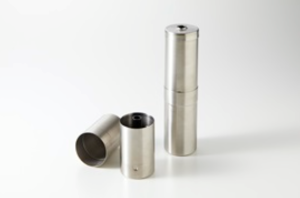
Stainless work-hardens fast under cold forming. Local over-strain can throw off subsequent piercing, machining, and dimensional control, while higher forming forces put more stress on die strength, alignment, and wear resistance.
Draw ratios, corner radii, blank-holder force, lubrication, and station sequencing all have to be set to control cracking and wrinkling while keeping the wall thickness uniform.
Precision features beyond the draw
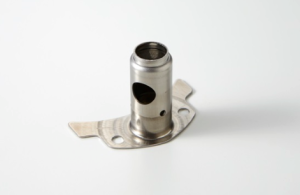
A solid stainless process often includes mating surfaces, pierced holes, and controlled edges on top of the basic drawn shape. Venting inside the tool matters where trapped air could distort the part. Edge finishing and final sizing need to be planned upfront, not patched in later.
Balford has developed stainless drawing sequences that can skip intermediate annealing for suitable materials and geometries, cutting handling steps while holding precision.
In-house die development
Tool design and build are matched to the material and geometry from the start. Our engineers calculate the number and order of forming stages and assess whether converting from a welded or machined process can reduce cost.
The development team validates every stage through tool trials and measurement before signing off the process for production.
Applications and process conversion
Applications and process conversion
Deep-drawn stainless parts show up in containers, housings, fittings, and industrial assemblies where corrosion resistance and service life are non-negotiable. Early on, we recommend reviewing material grade, wall thickness requirements, annual volume, and functional surfaces—that drives the most cost-effective forming approach.
Discuss Your Component
Need a stable process for a tough-to-form metal part?
Send Balford your print, material spec, annual quantity, and quality requirements. Our engineering team will walk through the forming sequence and recommend a practical manufacturing path.
Request a Manufacturing Review