Locally increasing wall thickness can strengthen a one-piece stamping and eliminate washers, welds, and excess material.
What is local thickening?
Local thickening is an integrated forming method that moves material into a targeted zone, allowing a single component to contain both thin and thick sections. The reinforced area improves strength and durability without requiring a heavier gauge across the entire blank.
This technique also gives designers more latitude to create functional transitions and curved geometries that would be difficult to achieve with conventional stamping alone.
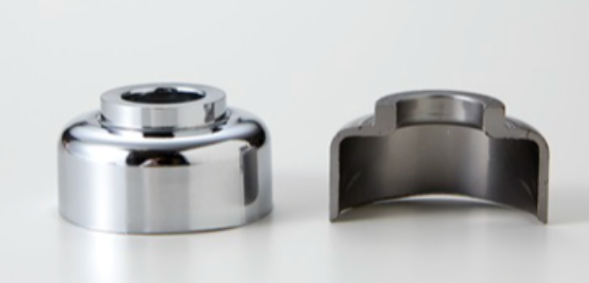
A high-strength material example
Balford developed a multi-stage process that locally increased a high-strength material to roughly twice its original sheet thickness while controlling buckling, folding, and cracking. In the formed region, work hardening raised strength to about 1.5 times that of the starting material.
The original assembly used a stamped cup, a separate washer, and welding. Forming the thickened feature directly into the cup turned the design into a single stamped component.
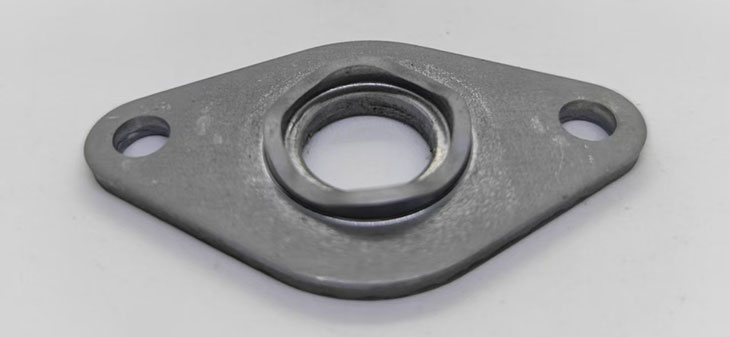
Three ways the process can reduce cost
- Less material: only the area needing additional strength is thickened, so the whole part doesn't require heavier sheet.
- Fewer operations: washers, welding, riveting, or secondary rolling may be eliminated.
- Lower weight: targeted reinforcement balances strength and mass, reducing material and transport impact.
Forming control
High-strength sheet doesn't stretch like mild steel—it's less ductile and puts a lot more load on the tooling. You have to break the material movement into several calculated stages, otherwise you'll get fractures or unwanted wrinkles. That's just the physics of it.
We use tooling simulation, die development, and controlled tryouts to lock in a repeatable production window before we ever commit to volume runs. That way, the process is stable from the first part off the press.
A practical way to consolidate parts
Local thickening pays off when your current design carries extra gauge across the whole part, or you're joining multiple pieces just to beef up one area. Send Balford the assembly and we'll take a hard look at whether a one-piece precision stamping can hit the same functional spec—often it can, and you cut out the welds and fasteners entirely.
Discuss Your Component
Need a stable production process for a tough metal part?
Send Balford your drawing, material spec, annual volume, and quality requirements. Our engineering team will walk through the forming sequence and give you a practical manufacturing route that makes sense for your part—not a generic quote.
Request a Manufacturing Review