A stamping die can cost more than the first year of parts, yet many purchase orders still describe it in one line: tooling, buyer-owned. That sentence does not say when title passes, which physical asset is covered, who holds the CAD and tool drawings, what maintenance is included, how a capacity increase is handled, or what condition the die must be in when the programme moves. A workable ownership record connects the commercial term to the physical tool and its technical history.
Who owns the die in metal stamping?
The buyer owns the stamping die only when the written agreement says so and the tool is tied to a purchase, asset ID and transfer condition. The agreement should distinguish title, possession, maintenance responsibility and the right to move the tool. A buyer-funded die may be owned from first payment, after final payment, or after a defined production milestone; a supplier-owned or amortised die usually remains supplier property unless ownership is transferred separately. Record the legal owner, physical custodian, tool number, drawing and revision, fixtures, spare inserts, CAD and tool drawings, maintenance terms, approved part revision, transfer trigger and required condition at handover. If title passes later, name who pays for preservation, packing, shipping and receiving inspection. Without those links, a general statement that the tool is buyer-owned does not reliably identify, protect or transfer the production asset.
A tooling agreement must answer four different questions
Ownership is often treated as one binary question. In practice, four questions need separate answers: who holds legal title, who has physical custody, who pays for maintenance and repair, and who may move or modify the tool. A supplier can legitimately operate a customer-owned die without owning it, or retain title while allowing the buyer to transfer it after a defined payment or capacity condition. These terms should be written for the specific die, not inherited from a generic purchase-order template.
| Model | What the agreement says | What must still be recorded |
|---|---|---|
| Buyer-owned, supplier custody | Title belongs to the buyer; the supplier keeps and operates the die. | Asset ID, possession, insurance, access, maintenance, modification approval and condition at transfer |
| Supplier-owned / amortised | The supplier owns the tool and recovers its cost through piece price, a tooling charge or agreed volume. | Whether title can transfer later, the price or trigger, and what happens if volume changes |
| Buyer-funded, delayed title | The buyer pays for the tool, but title passes only on a stated event. | Exact title event, payment evidence, lien or retention term, and transfer right |
| Shared or programme-specific | Ownership or rights differ by tool, insert, fixture or revision. | One asset record per item, how improvements are owned, and what happens when the programme ends |
What should a tooling ownership agreement contain?
| Record field | Why it matters |
|---|---|
| Legal owner and title event | Connects ownership to payment, acceptance or another defined milestone |
| Supplier custody and location | Identifies who physically holds the die and where it is stored or run |
| Permanent tool asset ID | Links the PO, tool drawing, parts, maintenance history and transfer record |
| Part and drawing revision | Prevents an earlier approved part from being run after an engineering change |
| Tool drawings, CAD and electronic files | Defines who receives design data and when it is supplied |
| Included components and spare inserts | Separates the main die from purchased or consumable components |
| Maintenance and repair responsibility | States normal upkeep, wear parts, damage, downtime and escalation |
| Modification and improvement ownership | Covers buyer-funded changes, supplier improvements and later reverse engineering |
| Transfer condition and logistics | Defines working order, cleaning, preservation, packing, export and documentation |
| End-of-life and disposal | States how obsolete tools are returned, stored, scrapped or certified |
Use one permanent tool ID from quotation to handover
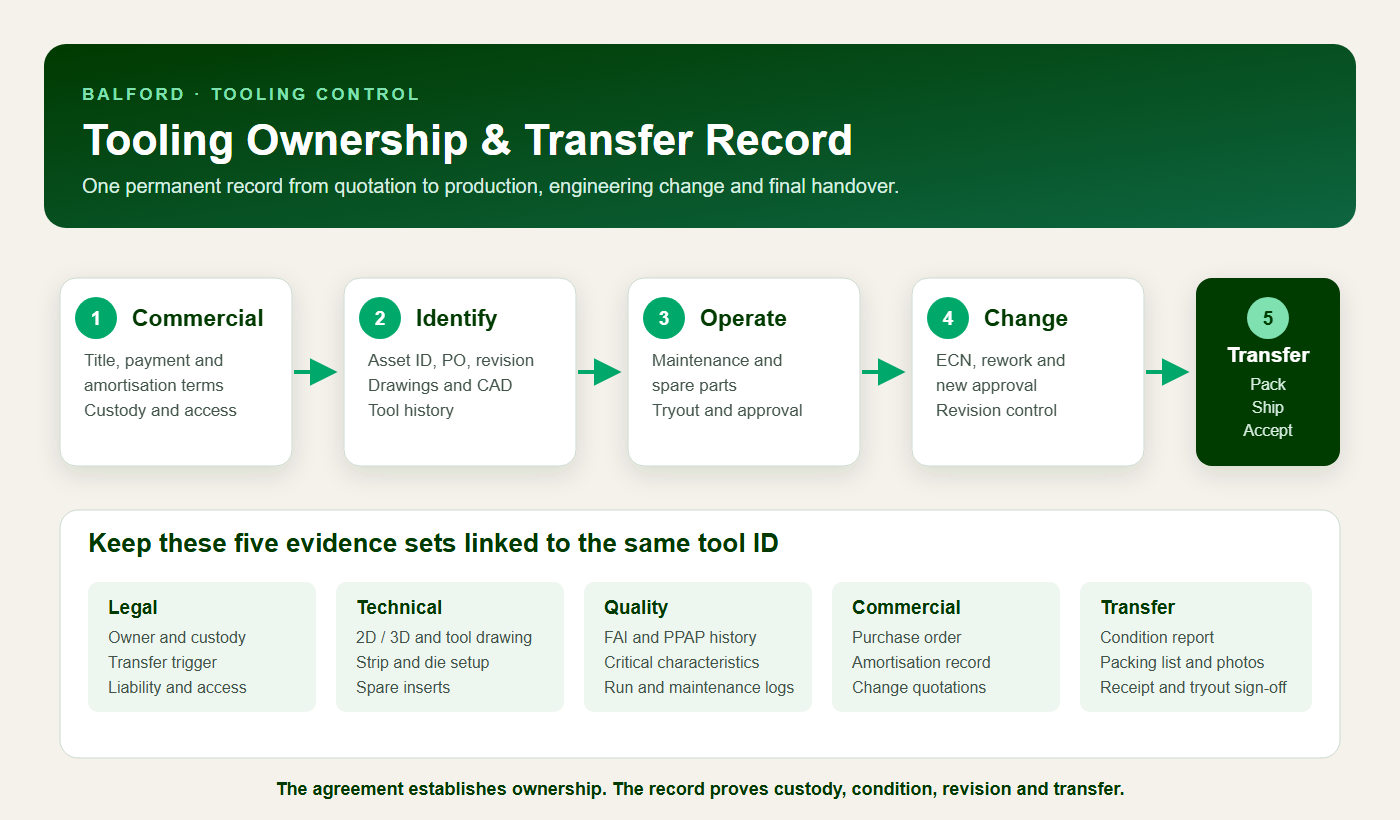
A tool name such as progressive die for housing is not an asset identifier. Assign one permanent ID and mark it on the tool, tool drawing, approved part drawing, maintenance record, PPAP package and transfer packing list. The ID should remain stable when the purchase order changes, the die is modified with a replaceable insert or the tool moves between plants. Add revision letters or numbers for each engineering change rather than creating a new record with no history. The record should show which part revision the tool currently produces and which earlier revisions remain physically possible.
How should a stamping die transfer to a new supplier work?
- Confirm in writing that the buyer has authority to move the tool and that the current supplier has no undisputed retention right.
- Match the physical tool ID to the purchase order, tool drawing, part drawing, current revision and maintenance log.
- Inspect the die before shipment and record visible condition, missing components, repairs, spare inserts, shut height and known production issues.
- Collect the last approved parts, FAI or PPAP record, critical dimensions, process monitoring data and the last known process settings.
- Agree the technical package: tool drawings, assembly drawings, CAD files, component lists, electrical or sensor diagrams and maintenance instructions.
- Clean, preserve and pack the die for transport, then photograph the packed tool and complete a signed packing list.
- At the receiving plant, record condition on arrival and try the tool only after confirming press compatibility, safety, shut height and tool protection.
- Run first-off and capability samples, inspect the agreed characteristics and link the receiving report to the same tool ID and revision.
What belongs in a tool handover pack?
| Pack | Required evidence |
|---|---|
| Commercial and legal | Tool purchase evidence, ownership and title event, custody term, transfer authority and any retention release |
| Technical | Tool assembly and detail drawings, CAD, strip or transfer layout, component list, spare parts, setup data and known modifications |
| Quality | Approved part drawing and revision, last FAI or PPAP report, critical dimensions, control plan, known deviations and recent capability data |
| Operation | Maintenance log, repair history, wear parts, press requirements, shut height, tonnage range, safety devices and storage instructions |
| Transfer | Condition report, photographs, packing list, weights and dimensions, shipping documents and receiving inspection record |
How do PPAP, FAI and tool revisions stay connected?
A transferred die is a new production situation even when the steel is unchanged. The receiving press, feed system, lubricant, operators, inspection plan and maintenance regime can alter the result. The buyer should connect the tool record to the first article inspection record, the required PPAP submission and the current part revision. PPAP Level 3 is Balford's standard submission for new programmes, but the customer's change process decides which PPAP elements must be resubmitted after a tool move. A new first-off measurement is not a substitute for the tool drawing, maintenance history or process record.
What should be inspected before accepting a transferred die?
- Tool identity: asset ID and revision match the record, and the part the tool is set up to produce matches the approved drawing.
- Tool structure: die set, guide pins, punches, inserts, springs, stops, lifters, sensors and safety devices are present and functional.
- Press compatibility: shut height, bed and ram dimensions, tonnage, feed height and mounting method fit the receiving press.
- Condition: rust, impact damage, cracked or chipped edges, worn guides, slug traps and missing fasteners are documented before tryout.
- Evidence: the last approved part, FAI or PPAP report, maintenance log, spare components and known process settings are available.
What changes when a tool moves from or to China?
The engineering record stays the same, but logistics adds documents and risks. Confirm the shipping and export responsibilities in the commercial terms, the customs description and value basis, the packing method for heavy tool sections and any Chinese or destination-country requirements that apply to the specific transaction. Treat legal, tax and customs questions separately from the engineering review and verify them with the responsible company or adviser. For the physical asset, agree who opens and inspects the crate, who pays for preservation, how corrosion is prevented and what evidence is recorded if the condition differs from the pre-shipment report.
How can Balford document a customer-owned tool?
Balford designs and builds stamping and deep drawing tooling in-house, and its predecessor business has built more than 4,000 single-hit drawing dies since 2000. For a customer-owned tool, the working records can connect the asset and part revision to the die drawing, maintenance and repair record, tryout result, first-article inspection and quotation for later changes. Balford runs presses from 25 t to 350 t and deep draws up to Ø250 mm, subject to drawing and material review. Bulk heat treatment, slow-wire EDM, plating and other specialised processes are carried out by qualified external partners where required and are stated in the process route rather than implied as in-house work.
What should a buyer send before a tooling transfer quote?
- The current tool drawings and latest approved part drawing with revisions.
- The last approved part, FAI or PPAP report, control plan and any open quality concerns.
- Tool dimensions, weight, press requirements, shut height and available maintenance or modification records.
- Photographs and a condition report, plus the expected transfer date and production restart requirement.
- Annual volume, batch pattern, required documents and which elements of the tool are buyer-owned or supplier-owned.
What wording should not be used on its own?
Tooling is buyer property is too incomplete to control a production asset. It should name the tool, the owner, the title event, the custodian, the included components and the transfer rule. Tooling included is similarly ambiguous because it may mean a lump-sum charge, amortisation, a one-off engineering fee or no separate charge at all. Buyer-approved also does not say which revision is approved or whether the approval covers a sample, a PPAP submission or full production. Precise wording protects both sides because it separates a commercial promise from the technical evidence needed to execute it.
Key point
The agreement should establish who owns the die, who holds it, who maintains it and when it can move. The permanent tool record should prove which physical asset, part revision, approvals, repairs and transfer condition belong to that ownership right.
Frequently asked questions
Does paying for the tool make the buyer the legal owner?
Payment is evidence that may support ownership, but the written agreement and applicable law decide when title passes. State the title event, the specific tool asset ID and any retention or transfer condition instead of relying on the invoice alone.
What should be included in a tooling ownership clause?
Include the legal owner, title event, physical custodian, asset ID, part and tool revisions, maintenance responsibility, modification rights, transfer condition and what happens at the end of the programme.
Who owns modifications made after the die is built?
The agreement should state that separately. A buyer-funded insert, repair or engineering change may belong to the buyer, while a supplier-funded improvement may remain supplier property unless the parties agree to transfer it.
Can a stamping die be moved to another supplier?
Usually this is possible when ownership and transfer rights are documented, but the die must be identified, inspected, packed and supported by its drawings, approved-part records, maintenance history and tryout evidence.
Does a transferred die need a new FAI or PPAP?
The receiving process, press and quality system are different, so the customer's change process normally requires new validation evidence. The exact FAI and PPAP submission depends on the part, customer requirements and what changed.