Cylinder Trolleys, Made to Drawing
Cylinder trolleys move oxygen, acetylene and other industrial gas cylinders with the cylinder held by a chain, so it cannot tip or slide off in transit.
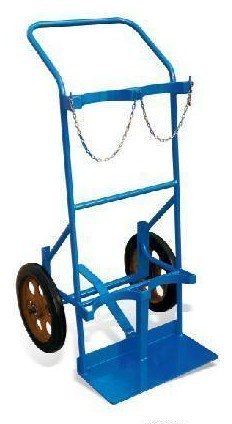
What we manufacture
The cylinder diameter and the number of cylinders decide the frame; the retaining chain and the support foot are what make the trolley safe to load and park.
- Single-cylinder trolley
- Two-cylinder trolley
- Ergonomic truck with a support foot or support wheel, for heavy cylinders
- Solid rubber wheels with roller bearings
- Powder-coated frame as standard
Cylinder trolleys are bought for two reasons: getting a heavy cylinder to the work without lifting it, and keeping it upright when it gets there. The support foot does the second job — it holds the loaded trolley without the operator steadying it.
Where cylinder trolleys are used
- Gas cylinder transfer
- Welding and cutting stations
- Filling and decanting areas
- Maintenance workshops
What to send with an enquiry
- Product type and a photograph, drawing or sample
- Overall length, width and height
- Working load and how the load is distributed
- Material and surface finish
- Wheel or castor requirement
- Quantity, packaging and destination
If any of these are still open, say so at enquiry stage — the review is where they get settled, and it is cheaper than discovering them after the first article.
Materials and finish
| Material | Where it is used | Finish |
|---|---|---|
| Carbon steel | The default for carts, trolleys and racks in dry workshops | Powder coating, or painted to a colour |
| Galvanized steel | Pallets, trays and storage in humid or outdoor conditions | Hot-dip galvanized by an audited partner |
| Stainless steel | Wet, washdown or corrosive environments, subject to grade review | Brushed or passivated |
Powder coating, galvanizing and plating are bulk finishing operations carried out by audited partner companies and declared as such on the quotation. Cutting, forming, welding and assembly run in Balford's own plant.
How it is made
Frames are cut, formed, welded and assembled in the same plant, so the blank size, the bend sequence and the weld fixturing are planned together. Where the product needs its own tooling, it is designed and built by Balford's own tool room.
Cylinder Trolleys FAQ
Why does a cylinder trolley need a retaining chain?
Because the cylinder is not fixed to the trolley: an unchained cylinder can slide, rotate or fall out on a kerb, a ramp or a rough floor. The chain, with the support foot or support wheel, is what keeps the trolley safe when it is loaded and parked.
Can the product be customised?
Yes. Dimensions, load capacity, deck or shelf arrangement, wheel and castor set, guardrails, handle position, colour and finish can all be changed, as long as the change is on the drawing.
What is the difference between a quotation and a drawing review?
The drawing review is where the load, the frame section, the wheel set and the finish are settled and any risk is flagged; the quotation prices that agreed design, with the capacity of the design we build stated on it.
Send Your Drawing for a DFM Review
Upload PDF, STEP, IGES or DXF at rfq.balford.net, or send a sample and a description of the handling problem. Engineering feedback is usually returned within one business day.
Related products and capabilities
Product family industrial carts and storage equipment