Shelf Storage Trolleys, Made to Drawing
Shelf trolleys move tools, components and cartons between workstations, with a three-sided guardrail and angled shelves that stop the load sliding when the trolley is pushed.
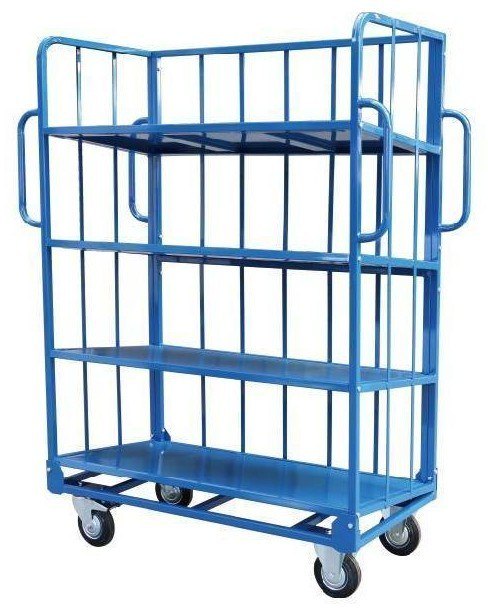
What we manufacture
Shelf count, shelf spacing and the guardrail are what make a trolley suit a workstation.
- Multiple shelf levels, spacing set by the load
- Angled shelves to stop loads sliding and falling
- Three-sided guardrail
- Two swivel castors with brakes plus fixed wheels
- Powder-coated frame in the colour required
A trolley that is pushed by hand sheds its load at the first change of direction unless the shelves are angled or guarded. That is why the guardrail and the shelf angle are specified together, not as options.
Where shelf storage trolleys are used
- Assembly lines
- Kitting and sequencing
- Tool rooms
- Warehouse picking
What to send with an enquiry
- Product type and a photograph, drawing or sample
- Overall length, width and height
- Working load and how the load is distributed
- Material and surface finish
- Wheel or castor requirement
- Quantity, packaging and destination
If any of these are still open, say so at enquiry stage — the review is where they get settled, and it is cheaper than discovering them after the first article.
Materials and finish
| Material | Where it is used | Finish |
|---|---|---|
| Carbon steel | The default for carts, trolleys and racks in dry workshops | Powder coating, or painted to a colour |
| Galvanized steel | Pallets, trays and storage in humid or outdoor conditions | Hot-dip galvanized by an audited partner |
| Stainless steel | Wet, washdown or corrosive environments, subject to grade review | Brushed or passivated |
Powder coating, galvanizing and plating are bulk finishing operations carried out by audited partner companies and declared as such on the quotation. Cutting, forming, welding and assembly run in Balford's own plant.
How it is made
Frames are cut, formed, welded and assembled in the same plant, so the blank size, the bend sequence and the weld fixturing are planned together. Where the product needs its own tooling, it is designed and built by Balford's own tool room.
Shelf Storage Trolleys FAQ
Why are the shelves angled rather than flat?
Because the trolley moves. An angled shelf uses gravity to keep the load against the back of the shelf while the trolley accelerates and stops, which is the difference between a trolley that can be pushed at walking pace and one that has to be nursed.
Can the product be customised?
Yes. Dimensions, load capacity, deck or shelf arrangement, wheel and castor set, guardrails, handle position, colour and finish can all be changed, as long as the change is on the drawing.
What is the difference between a quotation and a drawing review?
The drawing review is where the load, the frame section, the wheel set and the finish are settled and any risk is flagged; the quotation prices that agreed design, with the capacity of the design we build stated on it.
Send Your Drawing for a DFM Review
Upload PDF, STEP, IGES or DXF at rfq.balford.net, or send a sample and a description of the handling problem. Engineering feedback is usually returned within one business day.
Related products and capabilities
Product family industrial carts and storage equipment