Stainless Steel Hex Nuts and Threaded Fittings for Gas Sensors
A sensor hex nut is the threaded hex body that carries a gas sensor element into its boss: it seals against the exhaust or the pipe, provides the wrench flats for installation, and holds the bore that locates the element. Balford turns these from stainless bar to drawing, in the thread and hex sizes gas sensors actually use - M12 to M27 threads on hex sizes S14 to S30 - For the same assemblies we also supply the small PTFE insulators, bought out to drawing from qualified suppliers rather than made in our own plant.
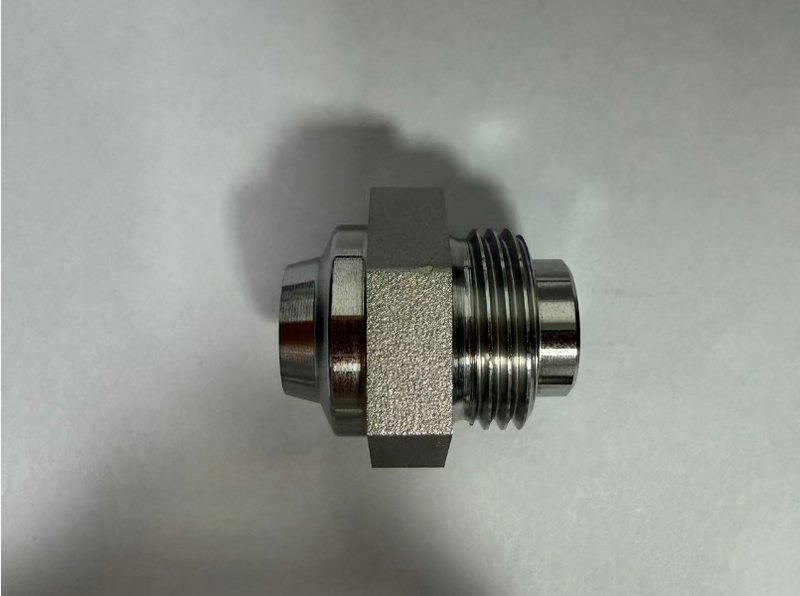
Families we turn
| Sensor family | Thread | Hex across flats | Material | Typical height |
|---|---|---|---|---|
| Oxygen sensor (automotive) | M18 | S22 | 430F / 430 stainless | 24.8 - 29.5 mm |
| Oxygen sensor (motorcycle) | M12 | S14 / S17 | 430F stainless | 16.5 - 23.9 mm |
| Nitrogen oxide (NOx) sensor | M20 / M22 / M27 | S22 / S24 / S30 | 304 / 430 stainless | 13.5 - 36.3 mm |
| Exhaust gas temperature sensor | M14 | S17 | 304 stainless | 13 - 18 mm |
| Other sensor fittings | to drawing | to drawing | PTFE (bought out) | 11 - 20.5 mm |
Outer diameters run from about 10.5 mm to 25 mm and bores from about 1.8 mm to 16.5 mm across the range. Every item is a non-standard part: the drawing decides the thread, the bore, the sealing face and the hex.
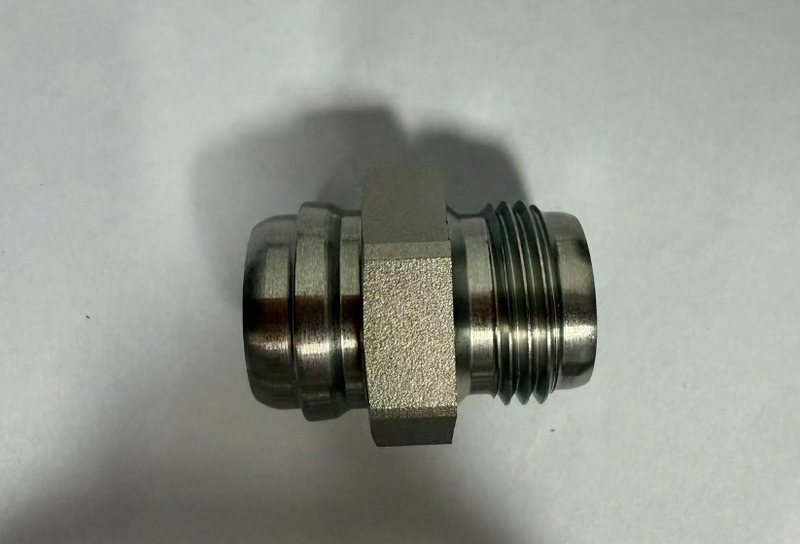
How they are made: CNC turning from bar
These are turned parts, not drawn or stamped. Round bar is machined on CNC lathes in one or two setups so the thread, the hex flats, the bore and the sealing face stay concentric to one another - which is the whole point of the part, because a hex nut that is not concentric to its bore will not seat the sensor squarely.
- Turning and threading on CNC lathes, with the bore and the thread produced from the same datum
- Bar material is bought in; turning, drilling, threading and inspection are in-house
- Stamped blanks are also machined in-house where a part is better started from a pressing
- Typical lead time for a new turned part: 7 to 15 calendar days from a confirmed drawing
- Bought out, not made here: the PTFE insulators and bushes on this page, together with bulk heat treatment, slow-wire EDM, passivation, electropolishing, plating, phosphating and liquid painting. Powder coating is split: large sheet-metal parts run in our own manual booth, small parts are coated by a partner on an automatic line. Hot forging, cold extrusion, cold heading, casting and powder metallurgy are bought as near-net pre-forms and finished by machining in-house.
For the machining side in more detail, see CNC machining services and CNC turning.
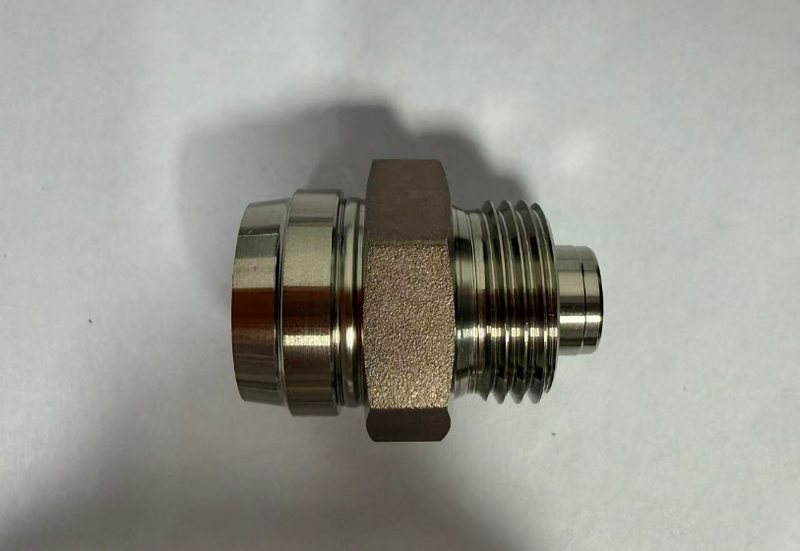
Materials
- 430F - free-machining ferritic stainless. The usual choice for oxygen sensor hex nuts: it machines cleanly, takes a thread well and resists exhaust corrosion without the nickel cost of 304.
- 430 - the same ferritic family without the free-machining addition, where a part is formed rather than heavily turned.
- 304 - austenitic stainless, used on NOx and exhaust gas temperature fittings where higher-temperature corrosion resistance matters more than machinability.
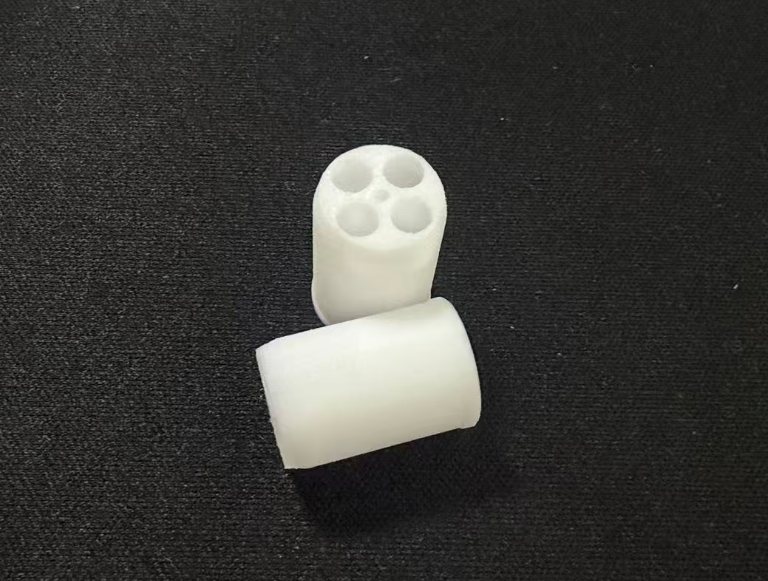
- PTFE - not a material we machine. The PTFE insulators and bushes used in these assemblies are bought out to drawing from qualified suppliers and supplied alongside our turned stainless parts. They are electrically insulating, low friction and unaffected by exhaust condensate; the drawing and the material grade are confirmed with the supplier before the lot is accepted.
Where these parts are used
- NOx and nitrogen oxide sensors
- Oxygen and lambda sensors
- Motorcycle oxygen sensors
- Exhaust gas temperature sensors
- Temperature sensor housings and deep drawn sensor housings - the drawn parts that sit alongside these fittings
- Automotive sensor and exhaust systems
Technical background: sensor housing tolerance guide, concentricity guide, NOx housing material selection.
Sensor hex nuts by thread size
Thread and hex size travel together, and the pair is normally fixed by the sensor the fitting has to take. The combinations below are the ones we have actually run; anything else is quoted to drawing.
| Thread | Hex across flats | Sensor family | Material we run |
|---|---|---|---|
| M12 | S14 / S17 | Motorcycle oxygen sensor | 430F stainless |
| M14 | S17 | Exhaust gas temperature sensor | 304 stainless |
| M18 | S22 | Automotive oxygen sensor | 430F / 430 stainless |
| M20 | S22 | NOx sensor | 304 / 430 stainless |
| M22 | S24 | NOx sensor | 304 / 430 stainless |
| M27 | S30 | NOx sensor | 304 / 430 stainless |
The thread, the bore and the hex flats are produced from the same datum, which is why the hex cannot drift relative to the bore. A fitting that is not concentric to its bore will not seat the sensor squarely.
By material: which grade for which fitting
| Grade | Magnetic | Why it is chosen | Typical part |
|---|---|---|---|
| 430F free-machining ferritic | Yes | Best machinability of the three, takes a clean thread, resists exhaust corrosion without the nickel cost of 304 | Oxygen sensor hex nuts, motorcycle fittings |
| 430 ferritic | Yes | The same family without the free-machining addition, where a part is formed rather than heavily turned | Formed fittings and brackets |
| 304 austenitic | Very slightly | Corrosion resistance for NOx and exhaust gas temperature fittings, and the choice where the assembly cannot tolerate a magnetic part | NOx and EGT fittings |
| PTFE (bought out) | No | Insulator and bush, not a structural part | Sensor insulators |
Magnetic behaviour is a real selection criterion on a sensor assembly, not a curiosity: see which materials are magnetic and why 304 and 430 behave differently in service.
By surface finish
| Finish | What it does | When it is quoted |
|---|---|---|
| As machined | Turned finish straight from the insert | Default for most fittings; the drawing may still call a maximum Ra |
| Passivated | Removes free iron and restores the passive layer on stainless | 304 and 430 parts for exhaust or humid service |
| Zinc or nickel plated | Corrosion protection, uniform appearance, solderability | Carbon-steel or brass fittings, or a part that must not show tarnish |
| Phosphated | Conversion coating that retains oil and reduces galling | Threaded parts that must run in without seizing |
| Electropolished | Brightens the surface and improves Ra by roughly 30–50% | Visible or clean-service parts |
Passivation, electropolishing, plating and phosphating are subcontracted processes for us and are disclosed as such on the quotation. See also typical Ra values by process.
Balford produces these hex nuts on presses from 25 t to 350 t, with the dies designed and built in its own tool room.
Frequently Asked Questions
Are these standard parts or made to drawing?
Made to drawing. The thread, hex size, bore and sealing face are all set by your drawing; we do not hold a catalogue of standard hex nuts. The table above shows the families we turn most often, with the sizes that recur.
What tolerance can you hold on the thread and the bore?
Thread and bore tolerance depend on the callout and the sealing method. Dimensions to 0.01 mm are possible on selected critical machined features where process, geometry, material and inspection conditions allow and the drawing confirms it - that is a drawing-confirmed exception, not a default tolerance.
How do you keep the hex concentric to the bore?
By producing the hex, the thread and the bore from the same datum, usually in one or two setups on a CNC lathe rather than across separate operations. Concentricity and runout are checked with a concentricity gauge and a 2.5D optical measuring projector.
What about the plastic parts?
No - they are bought out. The metal parts on this page are turned at Balford; the PTFE insulators are purchased to drawing from qualified suppliers and supplied with the metal fittings, either separately or as an assembly. We do not machine plastics in our own plant, and we say so rather than implying it.
Send a drawing for a DFM review and a quotation All Balford catalogues and data files are collected on the downloads page.
Automotive Sensor Hex Nuts & Plastic Accessories — product range, materials and dimensions (PDF)