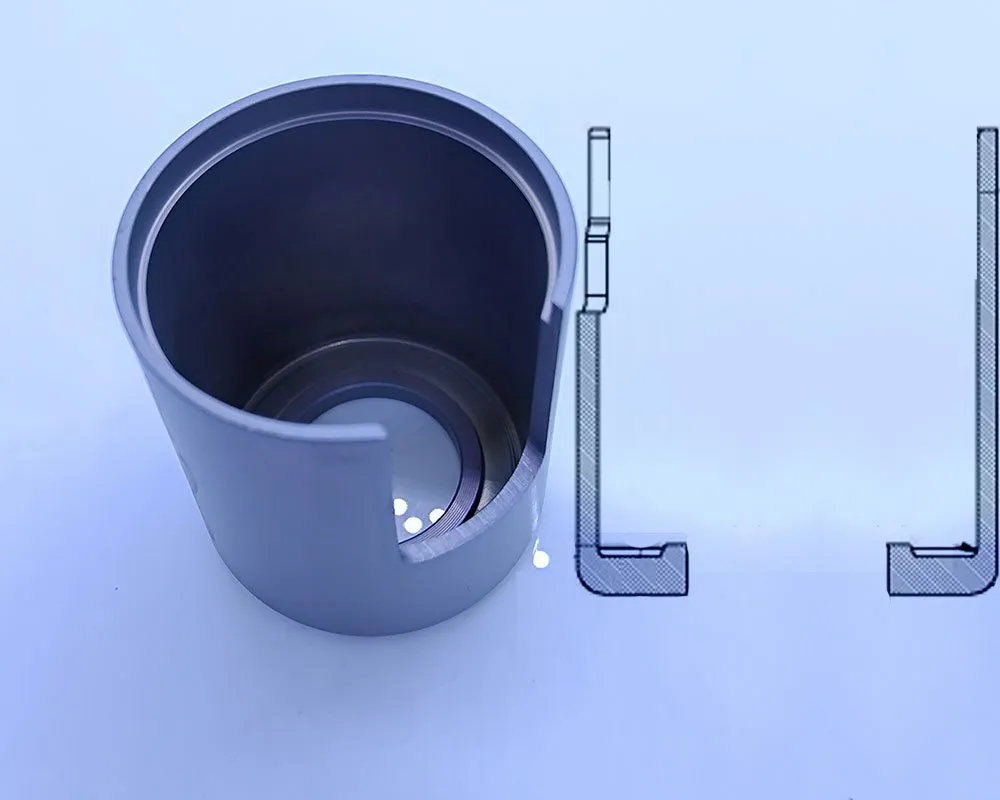
How deep drawn parts are actually made
Deep drawing is a cold forming process. A flat disc of sheet metal — the blank — is clamped between a blank holder and a draw die, and a punch pushes it down into the die cavity. The metal does not simply stretch around a shape: it flows. Material from the flange is drawn radially inward over the die radius and becomes the wall of the cup, while the bottom is formed from the sheet that sits under the punch. That is why a drawn cup can be deeper than its own diameter and still hold a wall close to uniform — something a welded or multi-piece assembly cannot match.
What this page is not about
Because “drawing” and “forming” get used loosely, one clarification is worth making. Deep drawing here means cold forming of sheet metal: low-carbon steel, stainless, aluminium, copper, brass and similar metals. It is not thermoforming. No plastic sheet is heated and pulled over a mould, no vacuum is drawn and no gas pressure is used. If the part you need is a plastic tray or a blister pack, deep drawing is the wrong process and this page will not help you.
Step 1 — Work out the blank
The blank diameter comes from the surface area of the finished part. The area of the flat blank and the area of the drawn shell are treated as equal, and a trimming allowance is added on top, because the rim of a drawn cup is never perfectly level.
- Blank diameter sets the draw ratio, and the draw ratio decides how many operations the part needs.
- Shape follows the part. A cylindrical cup starts from a disc; a rectangular or stepped part starts from a developed blank that follows its perimeter.
- Both errors cost. A blank that is too small leaves the cup short and thin at the top. A blank that is too large wastes material and raises the load on every draw in the sequence.
Step 2 — Decide the draw sequence
A single draw can only reduce the blank so far before the wall tears. For mild steel a first draw typically takes the blank down to about 0.50–0.55 of its diameter, which is a limiting draw ratio of roughly 1.8 to 2.0; each following redraw takes a further 15–25%. The four numbers that decide whether a part can be made at all are the draw ratio, the blank size, the draw force and the die clearance.
- Within the limit the part is drawn in one operation, and the cost structure is simple.
- Beyond the limit the cup is redrawn through a smaller die. Every redraw adds a press stroke, a die station and cost, so the sequence is planned to use the fewest operations the material will tolerate.
- Material changes the count. Stainless and aluminium work-harden faster than mild steel, so the same part usually needs more operations and more attention to the anneal between them.
Step 3 — Anneal between draws when the material asks for it
Cold working raises strength and reduces ductility. Once the accumulated reduction pushes the wall towards its forming limit, an intermediate anneal restores ductility before the next draw — otherwise the part tears at the die radius on the following operation. Annealing is a batch heat treatment: Balford coordinates it through a vetted partner and records it on the process route rather than presenting it as an in-house operation. The number and position of anneals is decided from the material and the total reduction, not chosen as a matter of taste.
Step 4 — Build the tooling
The tooling is where a drawing process succeeds or fails. Three settings carry most of the risk.
Die entry and punch nose radii
The die entry radius is usually set at 4 to 10 times the sheet thickness. Too small and the material cannot flow over it, so the wall thins or tears at the radius. Too large and the unsupported flange wrinkles instead of being pulled in. The punch nose radius matters for the same reason at the other end of the cup.
Die clearance
Clearance per side is normally around 1.1 to 1.3 times the sheet thickness on the first draw and tighter on later draws. Clearance too large lets the wall wrinkle and fold; too small increases friction and punch load and wears the die.
Blank holder force and lubrication
Blank holder force is the main lever between the two classic failures: too little and the flange wrinkles, too much and the wall tears. Lubrication works alongside it — a good lubricant drops the coefficient of friction from around 0.15 to about 0.05, which can cut punch load by up to 30% and extend tool life.
Which tool type to use
- Single-operation die — one draw per stroke; the simplest and cheapest option for one or two draws and modest volumes.
- Compound die — blanks the disc and draws it in the same stroke.
- Progressive die — strip-fed, several stations in one tool. Drawing depth in a progressive die is limited to roughly 1.5 times the part diameter, because the carrier strip cannot feed enough material into the forming station beyond that.
- Transfer die — the part is moved between separate stations, which allows deeper draws than a progressive die and is how deep housings are usually run at volume.
Step 5 — Iron the wall when it has to be controlled
Drawing alone thins the wall as material flows over the die radius, so the wall is thickest at the bottom and thinnest near the rim. When the drawing calls for a controlled wall, an ironing pass pushes the cup through a slightly smaller die and squeezes the wall to a defined thickness. The die sets the outside diameter and the punch sets the inside diameter, so both are held by tooling rather than by the starting strip. That is what allows a drawn and ironed housing to replace a machined one.
Materials that draw well
- Low-carbon steel (DC01, DC04, DC05) — the default for drawn housings. DC04 draws deeper before a redraw is needed.
- Stainless steel (304, 316L) — chosen for corrosion resistance. Harder to form, so expect more draws and more interstage annealing.
- Aluminium (1050A, 1100, 5754) — light parts with lower strength and different springback behaviour.
- Copper and brass — where conductivity or a soldered joint drives the material decision.
- Pure iron (DT4E) — for solenoid and magnetic parts where magnetic behaviour matters more than strength.
Defects, and what actually controls them
- Wrinkling in the flange — blank holder pressure too low for the material and the draw ratio.
- Tearing at the die radius — a reduction that exceeds what the material can take in one stroke, or a radius that is too tight.
- Earing — planar anisotropy in the strip leaves the rim uneven, so a trimming allowance is planned into the blank rather than chased afterwards.
- Wall thinning — controlled by the reduction sequence and, where a defined wall is required, by an ironing pass.
- Rough or orange-peel surface — coarse grain in the incoming strip, which is a material specification problem rather than a press setting.
- Dimensional drift — tool wear and strip variation, caught by in-process gauging rather than at the end of the run.
Inspection that actually proves the part
A drawing process is only as good as what you can show about the parts it produced. Balford runs checks at three points and documents them.
- First article against the drawing, including the features that will be hardest to hold once the tool is in production.
- In-process checks on the dimensions that drift: height, wall thickness and the diameters that mate with the customer's part.
- Final inspection on calibrated CMMs and dedicated gauges, with every dimension verified against the print.
- Documentation — material certificates with heat numbers, dimensional reports, and PPAP packages for automotive programmes.
On tolerance, one honest statement is worth more than a headline figure. Very fine tolerances in the 0.01 mm class are realistic only on selected machined features, and only where the process, geometry, material and inspection conditions allow; the achievable value for a specific feature is confirmed from the drawing during DFM review. They are not a general wall tolerance on a drawn shell. Wall thickness, concentricity between bore and outside diameter, shoulder height and the flatness of a sealing face are the features worth tightening.
What Balford can run
Balford has been forming metal since 2017 and runs presses from 25 t to 350 t in a 12,000 m² plant, with tooling designed and built in-house. For deep drawing that means a maximum draw diameter of Ø250 mm, a maximum blank of 600 mm, a maximum drawn height of 200 mm, and strip from 0.4 mm to 10 mm. The quality system is certified to ISO 9001:2015 with controls aligned to IATF 16949 requirements. Plating, phosphating, powder coating and batch heat treatment are carried out by vetted partners and declared as such; mechanical forming, machining and assembly are done in-house. Send a drawing and a quantity and you will get a DFM review and a quotation, normally within one business day.