
Deep Drawn Solenoid Valve Housings: Material Selection & Design for Automotive Applications
Summary
Solenoid valve housings for automotive braking systems (ABS, EBS) are a critical deep drawing application. The housing has to deliver magnetic permeability, pressure integrity, corrosion resistance, and dimensional stability—all at production volumes. Here's a practical look at material selection, design rules, and the manufacturing sequence for deep drawn solenoid enclosures.
Why Deep Drawing for Solenoid Valve Housings
Deep drawing is the go-to process for solenoid valve housings because it yields seamless, hollow parts with consistent wall thickness—something you can't get reliably from machining or welding. That uniformity matters for three reasons:
- Magnetic Circuit Performance: Consistent wall thickness keeps magnetic flux distribution even, so the solenoid responds predictably.
- Pressure Integrity: A seamless draw eliminates weld seams that can become leak paths under hydraulic or pneumatic pressure.
- Dimensional Accuracy:Tight tolerances on internal diameters and depths are critical for plunger fit and stroke control.
Material Selection for Solenoid Housings
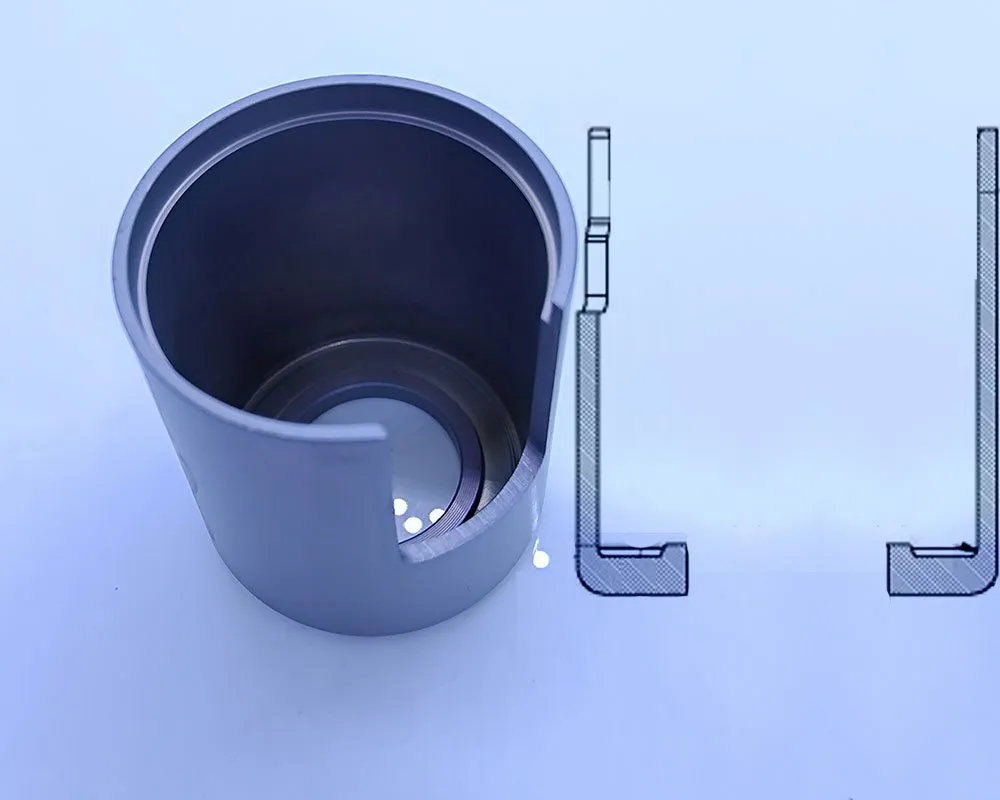
Material choice directly impacts magnetic performance, corrosion resistance, and formability. Balford works with a range of materials for solenoid applications:
| Material | Key Properties | Typical Applications |
|---|---|---|
| Low-Carbon Steel (e.g., 1008, 1010) | Good magnetic permeability, cost-effective, readily formable. Requires plating (e.g., zinc) for corrosion resistance. | Standard ABS and EBS solenoid housings for passenger vehicles. |
| Stainless Steel (e.g., 430F) | Good corrosion resistance and magnetic properties. Reduced formability compared to low-carbon steel. | Hydraulic valve housings requiring better corrosion protection. |
| Stainless Steel (e.g., 304, 316L) | Excellent corrosion resistance. Non-magnetic in annealed state; can become slightly magnetic after cold working. | Applications in harsh environments (e.g., commercial vehicles, off-highway). |
Design Consideration: For magnetic circuits, material permeability (μ) is a key parameter. Low-carbon steel offers a good balance of cost and magnetic properties. If corrosion resistance is paramount, a material like 430F stainless steel provides a compromise.
Design for Deep Drawing: Solenoid Housing Considerations
1. Draw Ratio and Geometry
The depth-to-diameter ratio is a primary driver of process complexity and cost.
- General Rule: If the part depth exceeds 1.5 times its diameter, a progressive die stamping approach becomes challenging. Deep drawing is required.
- Balford Capability: We specialize in challenging deep draws, including those with complex multi-stage reductions to achieve the required depth and wall thickness distribution.
2. Wall Thickness and Tolerances
- Critical Dimensions:Internal diameter for plunger fit, bottom thickness for pressure rating, and overall depth for stroke length.
- Achievable Tolerances:Selected critical machined features can be controlled to ±0.01 mm where process, geometry, material and inspection conditions allow. The achievable capability for a specific feature is confirmed from the drawing during DFM review, supported by ISO 9001:2015 certified controls aligned with IATF 16949 requirements.
3. Surface Finish
- Internal Surface:A smooth finish cuts plunger friction and reduces wear over the service life.
- External Surface:For plated components, a consistent surface is required for proper coating adhesion.
- Process Control:Our deep drawing process produces a smooth surface, often eliminating the need for secondary machining.
4. Flange and Mounting Features
- Flange Design:The flange (or lip) must provide a reliable sealing surface for O-rings or gaskets.
- Recommendation:Specify flatness and a defined surface roughness (Ra) on the flange to ensure a leak-tight seal under pressure.
5. Threads and Secondary Operations
- Threads:Threads, whether internal or external, are typically added as secondary operations—tapping or thread rolling—after the main deep drawing cycle is complete.
- Hole Piercing:Pilot holes or mounting holes can be added either through a secondary piercing step or integrated directly into the progressive die sequence.
Balford’s Manufacturing Process for Solenoid Valve Housings
Material Procurement:- We source certified material from approved mills, with full traceability and compliance to RoHS and REACH requirements.
- Material Procurement:Tooling Design: Our engineering team designs and builds multi-stage deep draw tooling, with attention to material flow and control of wall thinning.
- Tooling Design:Deep Drawing: We run the draw sequence on high-precision presses, controlling blank holder force and lubrication to hold consistent part geometry.
- Deep Drawing:Quality Inspection: In-process and final checks are done with calibrated CMMs and dedicated gauges, verifying every dimension against the print.
- Quality Inspection:Secondary Operations: Plating, heat treating, or thread rolling are handled in-house where practical, or coordinated through our vetted partner network.
- Secondary Operations:Advantages of Deep Drawn Solenoid Housings vs. Machined Alternatives
Deep Drawn Housing
Machined Housing (e.g., from bar stock)| Material Utilization | High (minimal scrap) | Low (significant material waste from machining) |
|---|---|---|
| Production Speed | High (suitable for volume production) | Slow (per-part cycle time is long) |
| Wall Thickness | Uniform, consistent | Can vary; relies on stock size |
| Part Integrity | Uniform, consistent | Can vary; relies on stock size |
| Part Integrity | No weld seams at all — the part comes out of the die as one continuous piece. | No weld lines — the housing is formed from a single blank, so there's nothing to grind or inspect. |
| Cost | Lower per-piece cost at volume — the tooling amortizes quickly once you're running coil-fed presses. | Higher per-piece cost |
| Lead Time | Longer upfront tooling lead time — expect 30–60 days for progressive and transfer die build and tryout. | Shorter tooling lead time — we can often cut that down with existing die platforms or soft tooling. |
FAQ: Engineering Questions on Solenoid Housings
Q: What materials does Balford recommend for a solenoid housing requiring both magnetic permeability and corrosion resistance?
A: For most applications, 430F stainless gives you a solid balance — it's magnetic and holds up reasonably in mild corrosive environments. If you need better corrosion resistance, 304 or 316L will work, but keep in mind they can become slightly non-magnetic after forming, which may weaken your magnetic circuit. I'd suggest confirming your flux requirements with your design team early. Our engineers can help with material selection and send samples for your validation testing.
Q: What is the maximum depth-to-diameter ratio Balford can achieve for a deep drawn solenoid housing?
A: It depends on the material and geometry. For typical automotive steels, we can hit draw ratios above 2.5:1 on the final part by using a sequence of draw reductions. If you send us your part drawing or target specs, we'll give you a concrete feasibility assessment.
Q: Can Balford produce solenoid housings with a flange and internal threads?
A: Yes. We can draw the flange as part of the forming process. Internal threads are usually added as a secondary operation — thread rolling is our go-to for strength and dimensional accuracy. We'll handle that as part of the full project scope, so you get a finished part ready for assembly.
Q: How does Balford ensure the pressure integrity of a deep drawn housing?
A: Our quality system covers material certifications and dimensional inspection throughout production. For pressure-retaining parts, we offer leak testing as a value-added service. Our ISO 9001:2015 certified system, with controls aligned to IATF 16949 requirements, means defect prevention is built into the process rather than caught only at final inspection.
Q: What certifications does Balford hold for automotive component manufacturing?
A: Balford is certified toISO 9001:2015and runs its quality management system toIATF 16949requirements, so our controls align with automotive industry expectations. We can also supply material certifications and RoHS/REACH declarations with your shipments.
Q: How can I get a quote for a deep drawn solenoid valve housing?
A: Send us your 2D drawing with tolerance callouts, the 3D model, material spec, and annual estimated quantity. We'll come back with a quote that breaks out tooling costs and per-piece pricing separately.