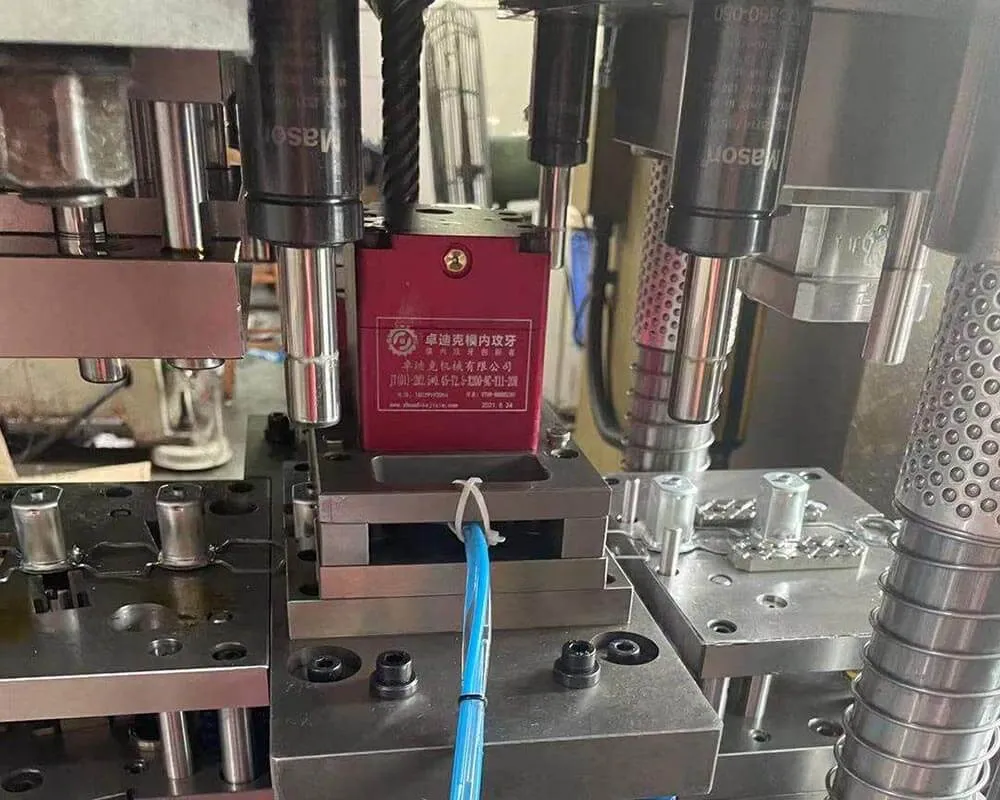
At Balford, we're always looking at ways to streamline manufacturing—cutting cycle times and trimming costs without compromising quality. That's what keeps us competitive as a fabricator. To that end, we've brought in in-die tapping technology, which is a real workhorse in progressive die stamping operations.
Traditionally, if a part needs threaded holes, you run it through the stamping press, then send it to a secondary tapping station. That adds handling, setup, and queue time, and it drives up cost per part. By building tapping units directly into the progressive die, we form the threads right in the press stroke, eliminating that separate operation entirely.
This approach marries thread forming with the stamping sequence, giving us high-speed, repeatable, and fully automated production. Since we're cutting out secondary handling and the associated labor, we see measurable gains in throughput and consistency—tighter tolerances and better thread quality, part after part.
We're committed to continuous improvement, and that means adopting process technologies that actually move the needle on efficiency. By investing in our team and integrating smarter tooling methods, we're holding the line on our commitment to sustainable practices.
In-Die Tapping FAQ
The in-die tapping unit is a compact mechanism that threads the hole while the part is still in the die. It converts the vertical reciprocating motion of the press slide into the rotary motion of an extrusion tap, so the thread is rolled or formed rather than cut. That's what lets us hit the thread spec without a separate tapping station.
This technology is a fit for continuous, progressive, and precision die sets. Because it's chipless, there's no chip management to deal with, no secondary cleanup, and no added handling. You get cleaner parts, stronger threads—thanks to the work-hardening effect of extrusion—and better overall throughput. The unit cycles with the press, handling feeding, positioning, piercing, and bending in sequence, and it works for both through-holes and blind holes. It's especially effective in sheet metal stamping on materials like aluminum, brass, and stainless steel.