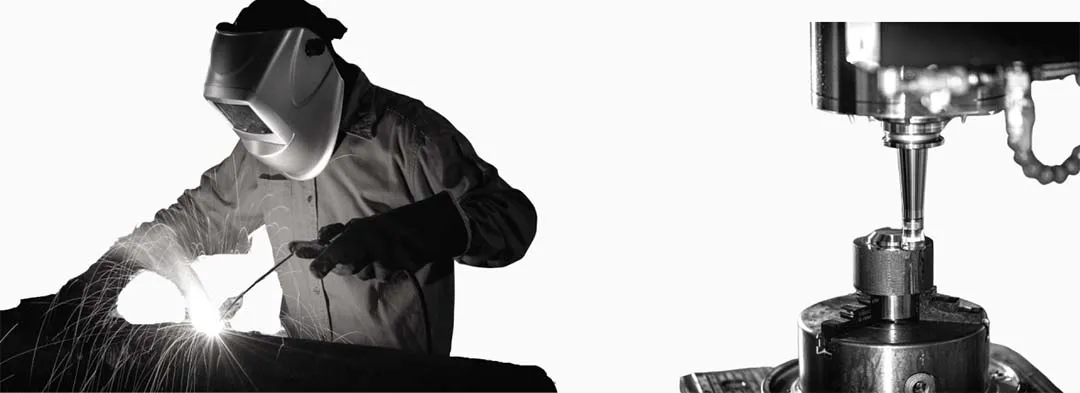
In this article, we'll cover the 25 mainstream metal processing methods used across the industry. These are the core techniques you'll encounter in everyday metalworking and fabrication.
What is metalworking
Metalworking is the production of parts, components, or large structures by applying various processes to metallic materials. It spans everything from oil rigs, ships, and bridges down to small engine parts and jewelry. To hit the required specs, you need a solid grasp of the available techniques, processes, and tooling.
What are the methods
Metal processing generally breaks down into three main categories: metal forming, metal cutting, and metal joining. Each covers a set of techniques for shaping, removing, or bonding metal materials.
Forming methods—like forging, rolling, and extrusion—change the shape and internal structure of the metal. Cutting processes—machining, drilling, sawing—remove material to get the final geometry. Joining methods—welding, soldering, brazing—fuse separate pieces into one assembly. All three are essential in fabricating metal components and structures.
1. Die casting
Die casting is a metal casting process where molten metal is forced under high pressure into a mold cavity. The dies are typically machined from higher-strength alloys, making the process similar in principle to injection molding but for metals.
2. Sand casting
Sand casting uses sand to form the mold. You start by placing a finished part or wooden pattern into the sand, then compact sand around it and let it set. The mold is usually made in two or more sections so the pattern can be removed before pouring. During mold-making, you create the sprue and vent holes for the metal to flow in and gases to escape. After pouring, the mold is left until the metal solidifies. Once the part is removed, the sand mold is broken apart—so each casting requires a fresh mold.
3. Investment casting
Investment casting, also called lost-wax casting, involves wax pressing, wax repair, tree assembly, dipping, dewaxing, pouring, and post-processing. You first make a wax pattern of the part, then coat it with ceramic slurry to build a shell. After the shell dries, it's fired to become a ceramic mold—during firing, all the wax melts out, leaving just the cavity. A pouring cup is typically added to the shell, and molten metal is poured in. Once cooled and solidified, you have the finished part.
4. Die forging
Die forging uses a die set and specialized forging equipment to shape a blank into a forged part. Depending on the press, you'll see hammer die forging, crank press die forging, flat forging machine die forging, friction press die forging, and others.
Roll forging is a plastic forming process where a pair of counter-rotating dies deforms the material to produce a forging or preform. It's a specific type of longitudinal rolling and is common in production shops.
5. Forging
Forging applies compressive force to a metal blank using a forging press or hammer, causing plastic deformation to achieve the required mechanical properties, shape, and size. Along with stamping, it's one of the two main branches of the forging process.
Forging has clear advantages. It eliminates as-cast defects like porosity from the smelting process and refines the grain structure. Because the metal's grain flow is preserved, forged parts generally have better mechanical properties than castings of the same alloy. For high-load, severe-service applications, forgings are often preferred over rolled plate, bar stock, or welded fabrications with simpler geometries.
6. Rolling
Rolling, or calendering, is a metal forming process where an ingot is passed through a set of rolls to reduce thickness and shape the material. The process is classified as hot rolling when the metal is above its recrystallization temperature, and cold rolling when below. Hot rolling is typically used for large reductions and initial shaping, while cold rolling provides tighter tolerances and a better surface finish. Calendering is the most common metalworking method, used across a wide range of industries for producing sheet, plate, and strip.
Die casting is a high-pressure process where molten or semi-liquid metal is injected rapidly into a steel die. The metal fills the cavity and solidifies under pressure, producing a casting with excellent dimensional accuracy and surface detail. This method is highly efficient for high-volume production of complex, precise parts, making it a go-to choice for OEMs needing consistent, repeatable components.
7. Low-pressure casting
Low-pressure casting uses low-pressure gas to fill a mold with molten metal, which then solidifies under controlled conditions. Originally developed for aluminum alloy castings, it's now also used for copper, iron, and even high-melting-point steels. The process yields castings with improved density, reduced porosity, and tighter dimensional tolerances compared to gravity casting. It's a solid choice for OEMs requiring high-quality structural components with good mechanical properties.
8. Centrifugal casting
Centrifugal casting involves pouring molten metal into a rotating mold, where centrifugal force distributes the metal and forms the part. Mold selection depends on part geometry, size, and production volume—options include sand, shell, or investment molds, as well as metal molds with a refractory or resin sand coating. This technique produces dense, high-quality castings with minimal porosity, making it ideal for cylindrical parts like bushings, rings, and pipes.
9. Lost foam casting
Lost foam casting starts with a foam pattern that matches the final part geometry. The pattern is coated with refractory paint, dried, and embedded in dry quartz sand. Molten metal is poured under vacuum, vaporizing the foam and filling the cavity. The result is a casting with no parting lines, no draft angles, and no flash—essentially a near-net shape. This process eliminates core shift and reduces dimensional errors, making it a precise, cost-effective option for complex geometries.
Lost foam casting is a near-net-shape process that requires minimal machining allowance. It eliminates the need for core removal, parting surfaces, and sand cores, producing castings free of flash, burrs, and draft. This also avoids dimensional errors caused by core misalignment. For OEMs, this translates to cleaner parts, less secondary work, and better consistency across production runs.
10. Squeeze casting
Squeeze casting, also called liquid die forging, injects molten or semi-solid metal into an open die, then closes it to form the part. High pressure is applied during solidification, causing plastic deformation of the solidified shell and isostatic pressing of the remaining liquid. The result is a part with superior mechanical properties and dimensional accuracy, effectively combining the benefits of casting and forging.
In direct squeeze casting, molten metal is poured directly into the open die cavity. Indirect squeeze casting injects the alloy through a punch into a closed die. Both methods apply high pressure during crystallization, yielding a dense, pore-free product. This process delivers castings with mechanical properties approaching forged parts, making it a strong option for high-stress applications where integrity is critical.
11. Continuous casting
Continuous casting pours molten metal into a water-cooled, open-ended mold. As the metal solidifies along the mold length, the strand is continuously withdrawn from the bottom. This produces long sections—billets, slabs, bars, or pipes—without the need for individual molds. The process is highly efficient, offering better yield and lower cost per ton compared to batch casting.
Continuous casting offers significant advantages over traditional ingot casting: higher throughput, improved material yield, and lower operating costs. The resulting product has better internal soundness, reduced porosity, and a cleaner surface. It's the standard method for producing steel, aluminum, and copper feedstock, giving downstream processes a consistent, high-quality starting material.
12. Drawing
Drawing is a cold-forming process where a metal blank is pulled through a die with a smaller cross-section, reducing its diameter and increasing its length. This is typically done at room temperature, hence the terms cold drawing or cold working. The process elongates and thins the material, producing wire, tube, rod, and other elongated profiles with tight tolerances and improved mechanical properties.
Cold drawing improves surface finish, increases tensile strength, and enhances dimensional accuracy compared to hot-rolled stock. It's widely used in manufacturing, construction, automotive, and aerospace for components that require precise cross-sections and consistent mechanical properties. For OEMs, drawn products offer reliable performance and predictable machining characteristics.
13. Stamping
Stamping is a cold-forming process where sheet metal, strip, or coil is fed into a press and formed using dies. The punch forces the material into the die cavity, causing plastic deformation or shearing to produce the desired shape. This method is highly efficient for high-volume production, delivering parts with tight tolerances and repeatable quality.
Stamping covers a wide range of operations—blanking, piercing, bending, deep drawing, and coining—allowing for complex geometries in a single or progressive die. It's a cost-effective solution for automotive, aerospace, electronics, and appliance components. With coil-fed presses and progressive tooling, we can hold tight tolerances and maintain consistent quality across millions of parts.
14. Metal Injection Molding (MIM)
Metal Injection Molding (MIM) is a near-net-shape process that combines powder metallurgy with plastic injection molding. Fine metal powders are mixed with a thermoplastic binder to create a feedstock, which is then injected into a mold cavity under high pressure. After cooling, the part is ejected as a 'green' component, ready for debinding and sintering.
The green part undergoes debinding to remove the binder—either thermally or with solvents—followed by high-temperature sintering to fuse the metal particles into a dense solid. MIM produces intricate, highly detailed parts with excellent dimensional accuracy, often eliminating secondary machining. It's a cost-effective alternative to CNC machining for small-to-medium-sized components in automotive, medical, and electronics.
15. Turning
Turning is a fundamental machining process performed on a lathe, where the workpiece rotates while a cutting tool removes material. It's the most common method for producing cylindrical, disc-shaped, or sleeve-like parts with rotational symmetry. The cutting action comes from the workpiece's rotation, allowing for efficient material removal and good surface finish.
Turning is ideal for machining internal and external cylindrical surfaces, tapers, end faces, grooves, threads, and contoured profiles. Most rotational parts can be effectively produced this way, and with CNC lathes, we can hold tight tolerances and achieve complex geometries in a single setup. It's a versatile, reliable process for a wide range of OEM components.
16. Milling
Milling uses a rotating cutter to remove material from a stationary workpiece, producing flat surfaces, slots, contours, and complex 3D shapes. Conventional milling handles simpler features, while CNC milling machines offer multi-axis capability for intricate geometries like molds, dies, and aerospace components. This flexibility makes milling a core process for prototype and production work.
CNC milling provides precise control and automation, enabling efficient production of complex parts with tight tolerances. Multi-axis machines can machine undercuts, angled features, and freeform surfaces in a single setup, reducing handling and improving accuracy. For OEMs, CNC milling is a reliable choice for both low-volume prototypes and high-volume production runs.
17. Planing
Planing is a machining process where a single-point cutting tool moves in a linear reciprocating motion across the workpiece to remove material. It's primarily used for producing flat surfaces, slots, and other linear features, especially on large parts. Planing typically achieves a precision of IT9 to IT7, with surface roughness (Ra) ranging from 6.3 to 1.6 micrometers.
Planing is well-suited for machining large workpieces or creating flat reference surfaces with specific dimensional and finish requirements. While it's less common than milling for small parts, it remains a practical option for heavy equipment components and tooling. The process offers good accuracy and a predictable surface finish, making it a dependable choice for certain applications.
18. Grinding
When selecting CNC milling as a machining method, it is important to leverage the advantages and key functions of CNC milling machines. These machines provide flexibility, accuracy, and the ability to handle complex geometries. By utilizing the capabilities of CNC milling machines, manufacturers can achieve superior results and optimize their production processes.
17. Planing
Planing is a cutting method commonly used for shaping parts. It involves the use of a planer, which moves in a horizontal linear reciprocating motion across the workpiece. Planing is primarily employed to achieve specific shapes and dimensions during the machining process.
Planing processing typically offers a precision range of IT9 to IT7, indicating the level of dimensional accuracy achieved. The surface roughness, measured by the parameter Ra, falls within the range of 6.3 to 1.6 micrometers (um). The Ra value describes the average roughness of the machined surface, with lower values indicating a smoother surface finish.
Planing is commonly used in various industries, especially for machining large workpieces or achieving flat surfaces with specific dimensions and surface finishes. It is important to consider the desired precision and surface roughness requirements when selecting planing as a machining method.
18. Grinding
Grinding is a common machining operation that removes excess stock from a workpiece using abrasive grains or wheels. We use it mainly to hold tight dimensions, improve surface finish, and bring parts into spec for final assembly.
In grinding, abrasive grains—typically bonded into wheels or used as loose media—are brought against the workpiece under controlled pressure and relative motion. The grains remove fine chips through cutting, plowing, and rubbing, which shapes the part and sets its final surface texture and dimensional accuracy.
Grinding works across a broad range of materials, including steels, aluminum, ceramics, composites, and certain non-metallics. It's standard in automotive, aerospace, tooling, and precision manufacturing where surface integrity and tolerance matter.
The main advantage of grinding is its ability to hold high precision, tight tolerances, and superior surface finishes. It's the go-to process for bearing races, gears, precision tooling, and parts with complex profiles or critical dimensions where machining alone won't get you there.
19. Selective Laser Melting (SLM)
Selective Laser Melting (SLM) is a metal additive process that uses a high-power laser—typically fiber or CO2—and metal powder to build fully dense parts. The build chamber holds a bed of fine, consistent powder that gets melted selectively, layer by layer.
In SLM, a computer-controlled laser scans the powder bed according to the CAD model, melting and fusing particles only where the beam hits. Each layer solidifies, then a fresh layer of powder is spread, and the process repeats until the part is complete. The result is a near-net-shape metal component with mechanical properties comparable to wrought material.
SLM is a form of metal 3D printing that lets us produce complex geometries and internal features you simply can't achieve with conventional machining or stamping. It's widely used in aerospace, medical, and automotive for custom, high-strength metal parts with tight tolerances and good fatigue life.
20. Surface
The laser melts and bonds the powder completely in the scanned areas, while unexposed powder stays loose. The whole operation runs inside a sealed chamber purged with inert gas to prevent oxidation.
21. Selective laser sintering
Selective Laser Sintering (SLS) uses an infrared laser as the heat source and works primarily with powder materials. The powder is preheated to just below its melting point, then leveled flat with a roller or blade before each pass.
The laser selectively sinters the powder based on the slice data from the CAD file, fusing particles into a solid layer. After each layer, the bed drops, new powder is spread, and the process repeats. Once complete, loose powder is removed to reveal the finished part.
Right now, SLS is mature for wax and plastic powders. Metal and ceramic powders are still under development for this process—they're workable, but the sintering window and part density need careful control.
22. Metal deposition Somewhat
Metal deposition—also called direct metal deposition or laser cladding—is similar to FDM but uses metal powder instead of filament. Powder is fed through a nozzle along with a high-power laser and inert shielding gas.
Unlike powder-bed systems that are limited by build box size, metal deposition can build large parts directly and is especially useful for repairing damaged precision components. You can add material exactly where it's needed, which cuts down on scrap and rework.
In practice, the powder is sprayed onto the target surface, and the laser melts it so it fuses metallurgically to the substrate. The inert gas keeps the melt pool clean and prevents oxidation, which is critical for bond quality and mechanical properties.
Metal deposition is used in aerospace, automotive, and tooling for on-demand fabrication and repair of complex metal parts. It gives you the flexibility to restore worn surfaces or build up features without starting from a solid block.
23. Roll Forming Roll forming
Roll forming runs a continuous strip of stainless steel through a series of roll stands, each one progressively bending the material until it reaches the final profile. The roll sequence is engineered so each pass deforms the metal incrementally—up to 36 stands for complex shapes, though simple profiles may only need three or four.
24. Die forging
Die forging uses shaped dies on dedicated forging equipment to compress a blank into a finished part. The result is a forging with tight dimensional accuracy, minimal machining allowance, and good structural integrity—plus high production rates once the tooling is proven out.
25. Die-cutting
Die-cutting is a blanking operation where the formed film or circuit is placed on the male die, and the die closes to trim away excess material while preserving the 3D shape that matches the cavity. It's a clean, efficient way to finish formed parts.
In die-cutting, the film panel or circuit sits on the bottom plate while the die mounts to the upper ram. The press applies downward force to control the blade and cut through the material. Unlike a punching die, die-cutting leaves a smoother edge. You can also adjust cutting pressure and depth to get effects like scoring or half-cut lines. Tooling is cost-effective, and the process is safe, fast, and easy to run.