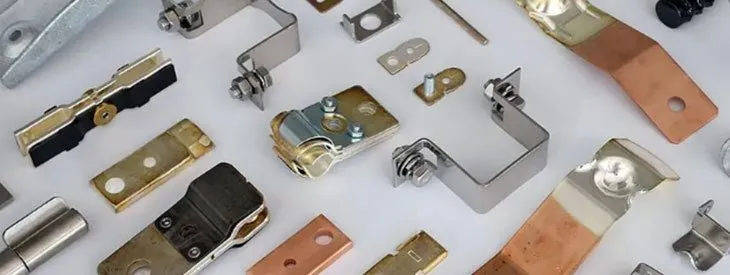
Selecting the right material for cold stamping depends on several factors: part geometry, required strength and surface finish, and the service environment the component will see in the field.
Stamping is a forming process where presses and tooling apply force to sheet metal, strip, tube, or profile stock to induce plastic deformation or separation, producing parts to specified shape and size. Key operations include blanking, piercing, bending, deep drawing, forming, and secondary finishing. The three pillars of stamping are the process and die design, the stamping equipment, and the raw material—all must work together to yield quality stamped parts. Precision hardware stampings are categorized by industry, application, and process characteristics.
What are precision hardware stampings?
- Automotive components: structural parts, functional brackets, lathe-turned mating parts, relays, and related stampings.
- Electronic components: connectors, contact brushes, electrical terminals, and elastic spring elements.
- Appliance parts: large appliance components such as CRT electron gun parts, plus small appliance structural and functional stampings.
- IC lead frames: lead frames for discrete devices and integrated circuits.
- Motor laminations: single-phase series, household, shaded-pole, permanent magnet DC, industrial, and plastic-bonded stator cores.
- Transformer cores: E, EI, and I-shaped laminations for transformers and similar magnetic applications.
- Heat exchanger fins: industrial, residential, and automotive heat exchanger fin stock.
- Other parts: instrument components, IT hardware, acoustic and camera parts, office equipment, and everyday consumer hardware.
Advantages of Precision Stamping
- Stamping offers high productivity and is straightforward to operate, making it easy to mechanize and automate. A standard press runs dozens of strokes per minute; high-speed presses can hit hundreds or over a thousand. Each stroke can produce a complete part, so throughput is hard to beat.
- Because the die controls part dimensions and geometry, stamped parts hold tight tolerances without compromising surface quality. Dies also have long service lives, so quality stays consistent and parts are highly interchangeable—essentially identical from lot to lot.
- Stamping handles a wide range of part sizes and complexities, from tiny watch components to large automotive frame rails and body panels. Plus, cold working work-hardens the material, so stamped parts often have higher strength and stiffness than the starting stock.
- Stamping generates no chips or scrap in the traditional machining sense, uses material efficiently, and requires no heating equipment. That makes it a cost-effective, energy-efficient process, and stamped parts come in at a lower unit cost.
Precision Stamping Process Issues
Common stamping defects include: deformation and burrs on precision parts; cracks, warping, surface scoring, and corner distortion on bent parts; flange wrinkles, wall wrinkles, wall damage, and cracking on deep-drawn parts; and edge cracks or uneven stretching on formed features.
Here's how to address them: design dies with proper punch-to-die clearance, corner radii, and machining tolerances. For bending, incorporate springback compensation in the tooling and use appropriate radii to prevent cracking. For deep drawing, use a blank holder with controlled pressure to suppress wrinkling, apply proper lubrication to reduce drawing resistance and prevent die galling or part tearing, and use a stamping oil that meets the process requirements.