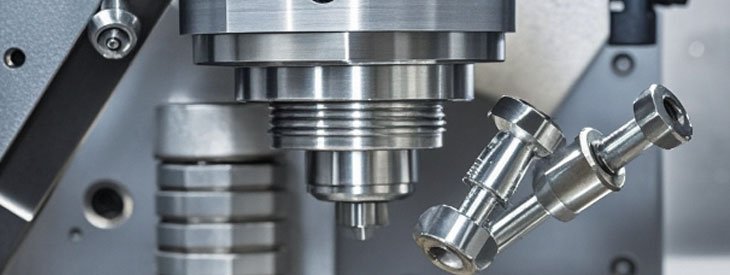
The housing shields the coil and moving parts of a solenoid valve while serving as the dimensional datum for assembly. Its machining quality directly impacts sealing integrity, magnetic circuit performance, and overall service life.
What is a solenoid valve housing?
A solenoid valve housing is the drawn metal shell that carries the coil, the plunger and the seal of a solenoid valve. It is also called a solenoid housing, a valve body shell, or - on fuel and air-suspension valves - a magnetic sleeve or magnet frame. It is a formed part rather than a casting or a weldment: a blank is deep drawn into a cup, redrawn or ironed to the finished wall, and machined only where it seals or locates, which keeps the magnetic circuit continuous and the part leak-tight with no seam. Housings we quote run from about 0.3 mm to 1.5 mm of wall, and the grade is chosen for the magnetic duty as much as for strength: low-carbon steel and pure iron where flux matters, 304 or 316L where the valve sees coolant or fuel, brass where it is soldered into a manifold.
I. Material selection
Choose stainless steel, low-carbon steel, aluminum, or another alloy based on corrosion resistance, magnetic properties, strength, and the working medium. Keep the grade and incoming material condition traceable through mill certs and lot records.
II. Machining accuracy
Control the inner diameter, outer diameter, concentricity, flange flatness, and assembly features to the print. Coordinate deep drawing and secondary machining up front so accumulated tolerances stay within spec and don't drift across the run.
III. Sealing treatment
Sealing faces must be free of burrs, cracks, and draw marks. Match groove dimensions and surface finish to the chosen seal, and run leak testing where the application calls for it—don't skip it on critical media.
IV. Processing technology
The draw ratio, tooling radii, lubrication, and intermediate annealing determine whether the housing forms without thinning or wrinkling. Also make sure any surface treatment is compatible with the base metal and the final operating environment.
V. Quality inspection
Inspection typically covers appearance, dimensions, material verification, coating thickness, cleanliness, and sealing performance. Set up control plans and gauges before mass production starts, not after issues surface.
In conclusion, reliable solenoid valve housings come from tight coordination across material selection, machining accuracy, sealing, manufacturing process, and inspection—each step feeds the next.