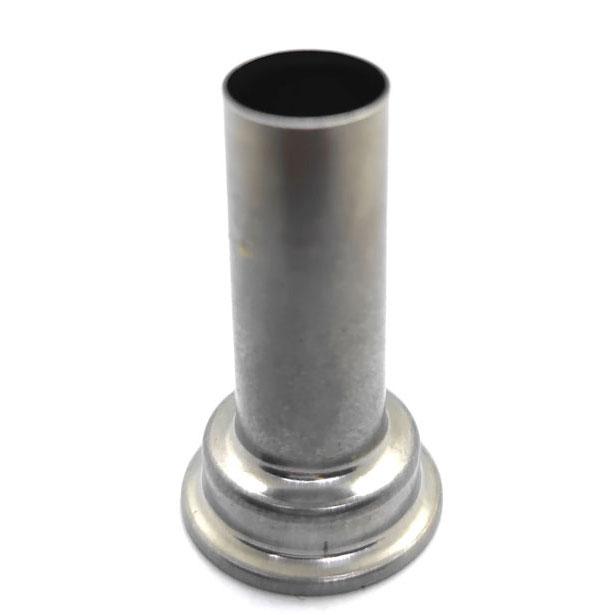
Stainless Steel Housing for ABS Wheel Speed Sensor – 316L
What is this part? Stainless Steel Housing for ABS Wheel Speed Sensor is a Sensor Housing manufactured from 316L stainless steel by Balford. Production process: Deep Drawing → Surface Treatment. Key dimensions: Dozens of housing geometries and sizes stocked; custom to drawing. Key requirements: Bottom wall ground to a controlled thickness for reliable signal transmission.

Deep Draw Metal Stamping
| Product Name | Stainless Steel Housing for ABS Wheel Speed Sensor |
|---|---|
| Category | Sensor Housing |
| Process Flow | Deep Drawing→Surface Treatment |
| Material | 316L stainless steel |
| Key dimensions | Dozens of housing geometries and sizes stocked; custom to drawing |
| Key requirements | Bottom wall ground to a controlled thickness for reliable signal transmission |
Case Review
ABS wheel speed sensor housings are deep drawn from 316L stainless steel, with the bottom wall automatically ground to a controlled thickness for reliable signal transmission. Balford stocks tooling for dozens of housing geometries and sizes and runs a full in-house stamping operation dedicated to sensor housings — the broadest range of configurations in the market. Housings are supplied to Tier 1 and OEM programs across the automotive aftermarket (IAM) and original equipment service (OES) channels, plus commercial vehicles, two-wheelers, e-mobility and autonomous platforms, from DFM through PPAP. Every year over a hundred new sensor housing designs reach their start-of-production (SOP) milestone at Balford.
What this case is
ABS wheel speed sensor housings are deep drawn from 316L stainless steel, with the bottom wall automatically ground to a controlled thickness for reliable signal transmission. Balford stocks tooling for dozens of housing geometries and sizes and runs a full in-house stamping operation dedicated to sensor housings — the broadest range of configurations in the market. Housings are supplied to Tier 1 and OEM programs across the automotive aftermarket (IAM) and original equipment service (OES) channels, plus commercial vehicles, two-wheelers, e-mobility and autonomous platforms, from DFM through PPAP. Every year over a hundred new sensor housing designs reach their start-of-production (SOP) milestone at Balford.
At a glance
| Field | Published value |
|---|---|
| Application | Automotive sensor housings |
| Industry | Automotive |
| Material | 316L stainless steel |
| Manufacturing route | Deep drawing → Surface treatment |
| Key dimensions | Dozens of housing geometries and sizes stocked; custom to drawing |
| Key requirements | Bottom wall ground to a controlled thickness for reliable signal transmission |
Manufacturing route
The published sequence for this part:
- Deep drawing
- Surface treatment
What decides the engineering
The route starts with deep drawing, so blank size, draw ratio, number of stages and whether an intermediate anneal is needed all follow from the drawing rather than from a catalogue shape. Where the wall has to be thinned while both diameters are held, ironing is added to the schedule.
Two things are settled before tooling: which dimensions actually matter to the assembly - a sealing face, a bearing seat, a coaxial diameter - and what tolerance the process can hold at those features. Everything else follows the general tolerance, which keeps tooling effort where it buys function.
Surface treatment sits at the end of the route. Cleaning and deburring are done in house; plating, phosphating, passivation, electropolishing and coating are placed with qualified external processors and recorded on the inspection plan, and batch heat treatment is handled the same way when the drawing calls for it.
Documentation and first article
A part like this is released with a first article inspection report against the confirmed drawing and a PPAP-aligned package at the level the customer's quality department asks for. Material certificates are kept per heat and IMDS entries are filed on request. The quality system is ISO 9001:2015 with process controls aligned to IATF 16949 requirements.